Absolute Convergence and Divergence — Question 4

PDF ↗

Question 4

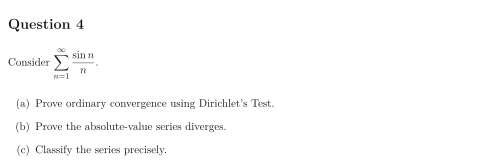
Consider ∑n=1∞sin⁡nn\displaystyle\sum_{n=1}^{\infty}\frac{\sin n}{n}.

  1. Prove ordinary convergence using Dirichlet’s Test.

  2. Prove the absolute-value series diverges.

  3. Classify the series precisely.

Original worksheet page 1: question and worked solution for 4-9-004
Show solutionHide solution

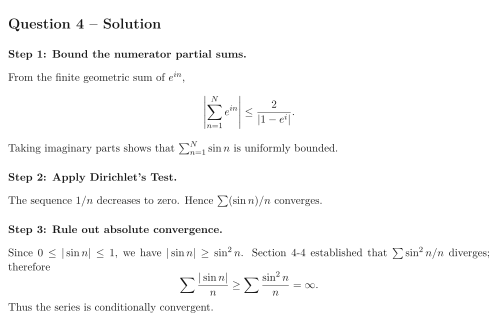
Question 4 – Solution

Step 1: Bound the numerator partial sums.

From the finite geometric sum of eine^{in}, |∑n=1Nein|≤2|1−ei|.\left|\sum_{n=1}^N e^{in}\right|\le\frac2{|1-e^i|}. Taking imaginary parts shows that ∑n=1Nsin⁡n\sum_{n=1}^N\sin n is uniformly bounded.

Step 2: Apply Dirichlet’s Test.

The sequence 1/n1/n decreases to zero. Hence ∑(sin⁡n)/n\sum(\sin n)/n converges.

Step 3: Rule out absolute convergence.

Since 0≤|sin⁡n|≤10\le|\sin n|\le1, we have |sin⁡n|≥sin⁡2n|\sin n|\ge\sin^2n. Section 4-4 established that ∑sin⁡2n/n\sum\sin^2n/n diverges; therefore ∑|sin⁡n|n≥∑sin⁡2nn=∞.\sum\frac{|\sin n|}{n}\ge\sum\frac{\sin^2n}{n}=\infty. Thus the series is conditionally convergent.
Original worksheet page 2: question and worked solution for 4-9-004

Original worksheet layout. Use Enlarge or open the PDF for a closer view.