Absolute Convergence and Divergence — Question 6

PDF ↗

Question 6

Consider ∑n=2∞(−1)nnln⁡n\displaystyle\sum_{n=2}^{\infty}\frac{(-1)^n}{n\ln n}.

  1. Verify ordinary convergence with the AST.

  2. Test absolute convergence using the logarithmic benchmark.

  3. Classify the series and state an alternating error estimate.
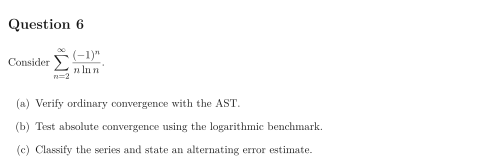
Original worksheet page 1: question and worked solution for 4-9-006
Show solutionHide solution

Question 6 – Solution

Step 1: Verify the AST.

Let bn=1/(nln⁡n)b_n=1/(n\ln n). For n≥2n\ge2 it is positive. Its denominator is increasing, so bnb_n decreases, and bn→0b_n\to0. Thus the alternating series converges.

Step 2: Test absolute convergence.

The absolute series is ∑1/(nln⁡n)\sum1/(n\ln n). For f(x)=1/(xln⁡x)f(x)=1/(x\ln x), ∫2bf(x)dx=ln⁡(ln⁡b)−ln⁡(ln⁡2)→∞.\int_2^b f(x)\,dx=\ln(\ln b)-\ln(\ln2)\to\infty. The Integral Test proves divergence.

Step 3: Classify and estimate.

The original series is conditionally convergent, with |S−sN|≤1(N+1)ln⁡(N+1).|S-s_N|\le\frac1{(N+1)\ln(N+1)}.
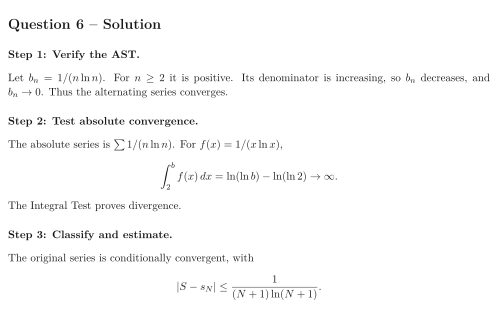
Original worksheet page 2: question and worked solution for 4-9-006

Original worksheet layout. Use Enlarge or open the PDF for a closer view.