Absolute Convergence and Divergence — Question 8

PDF ↗

Question 8

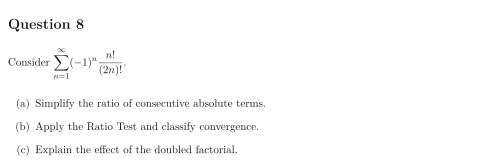
Consider ∑n=1∞(−1)nn!(2n)!\displaystyle\sum_{n=1}^{\infty}(-1)^n\frac{n!}{(2n)!}.

  1. Simplify the ratio of consecutive absolute terms.

  2. Apply the Ratio Test and classify convergence.

  3. Explain the effect of the doubled factorial.
Original worksheet page 1: question and worked solution for 4-9-008
Show solutionHide solution

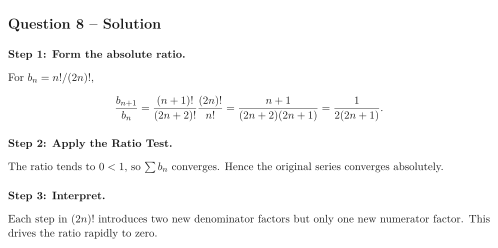
Question 8 – Solution

Step 1: Form the absolute ratio.

For bn=n!/(2n)!b_n=n!/(2n)!, bn+1bn=(n+1)!(2n+2)!(2n)!n!=n+1(2n+2)(2n+1)=12(2n+1).\frac{b_{n+1}}{b_n}=\frac{(n+1)!}{(2n+2)!}\frac{(2n)!}{n!} =\frac{n+1}{(2n+2)(2n+1)}=\frac1{2(2n+1)}.

Step 2: Apply the Ratio Test.

The ratio tends to 0<10<1, so ∑bn\sum b_n converges. Hence the original series converges absolutely.

Step 3: Interpret.

Each step in (2n)!(2n)! introduces two new denominator factors but only one new numerator factor. This drives the ratio rapidly to zero.
Original worksheet page 2: question and worked solution for 4-9-008

Original worksheet layout. Use Enlarge or open the PDF for a closer view.