Question 8
Prove using components that the midpoint of points with position vectors and has position vector .

Show solutionHide solution
Question 8 – Solution
Write every vector in matching component order. Perform scalar multiplication before addition or subtraction, then interpret the resulting components in the context of the problem.
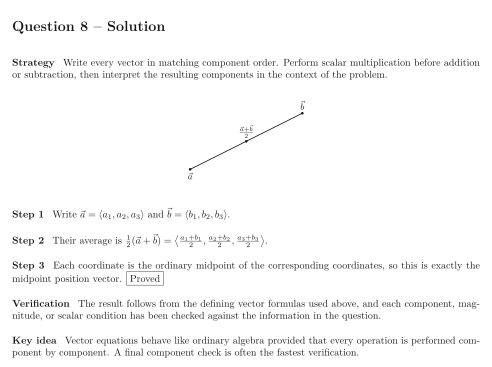
See the diagram in the original worksheet below.
Write and .
Their average is .
Each coordinate is the ordinary midpoint of the corresponding coordinates, so this is exactly the midpoint position vector.
The result follows from the defining vector formulas used above, and each component, magnitude, or scalar condition has been checked against the information in the question.
Vector equations behave like ordinary algebra provided that every operation is performed component by component. A final component check is often the fastest verification.