Question 2
Find the area of the triangle with vertices , , and .

Show solutionHide solution
Question 2 – Solution
Keep the component order and signs organized when expanding the determinant. After computing the cross product, use a dot-product check or the relevant magnitude formula to interpret it.
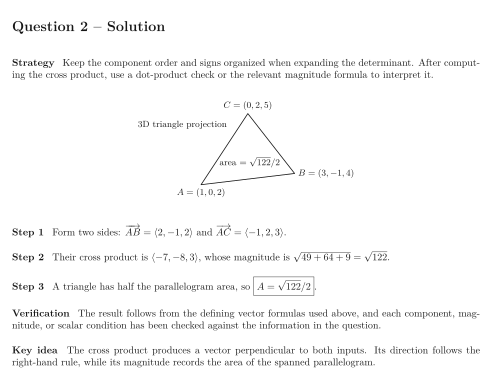
See the diagram in the original worksheet below.
Form two sides: and .
Their cross product is , whose magnitude is .
A triangle has half the parallelogram area, so .
The result follows from the defining vector formulas used above, and each component, magnitude, or scalar condition has been checked against the information in the question.
The cross product produces a vector perpendicular to both inputs. Its direction follows the right-hand rule, while its magnitude records the area of the spanned parallelogram.