Question 10
Vectors and have lengths and , and . Find every possible angle between them in .

Show solutionHide solution
Question 10 – Solution
Keep the component order and signs organized when expanding the determinant. After computing the cross product, use a dot-product check or the relevant magnitude formula to interpret it.
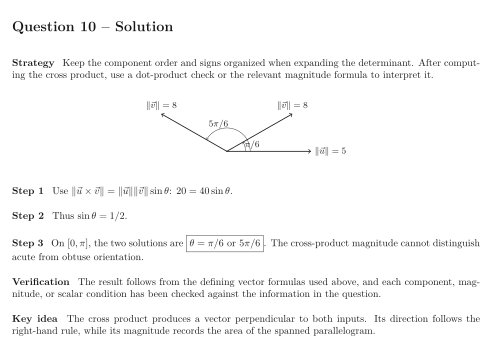
See the diagram in the original worksheet below.
Use : .
Thus .
On , the two solutions are . The cross-product magnitude cannot distinguish acute from obtuse orientation.
The result follows from the defining vector formulas used above, and each component, magnitude, or scalar condition has been checked against the information in the question.
The cross product produces a vector perpendicular to both inputs. Its direction follows the right-hand rule, while its magnitude records the area of the spanned parallelogram.