Question 6
Describe geometrically the set of all points equidistant from and . Derive a Cartesian equation for the set and show that the midpoint of belongs to it.

Show solutionHide solution
Question 6 – Solution
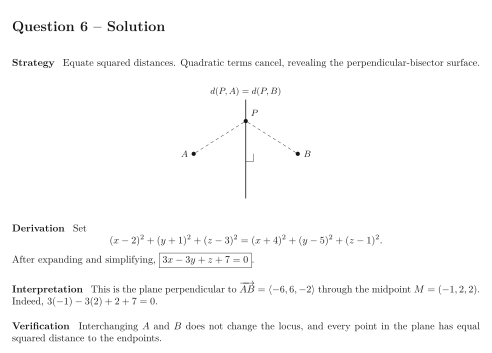
Strategy Equate squared distances. Quadratic terms cancel, revealing the perpendicular-bisector surface.
See the diagram in the original worksheet below.
Derivation Set After expanding and simplifying, .
Interpretation This is the plane perpendicular to through the midpoint . Indeed, .
Verification Interchanging and does not change the locus, and every point in the plane has equal squared distance to the endpoints.