The 3-D Coordinate System — Question 9

PDF ↗

Question 9

Four points are A=(1,1,1)A=(1,1,1), B=(5,1,1)B=(5,1,1), C=(3,1+23,1)C=(3,1+2\sqrt 3,1), and D=(3,1+2/3,1+42/3)D=(3,1+2/\sqrt 3,1+4\sqrt{2/3}). Prove that they are the vertices of a regular tetrahedron and find its center.

Original worksheet page 1: question and worked solution for 6-1-009
Show solutionHide solution

Question 9 – Solution

Strategy A tetrahedron is regular if all six pairwise distances agree. Symmetry suggests that its center is the average of its four vertices.

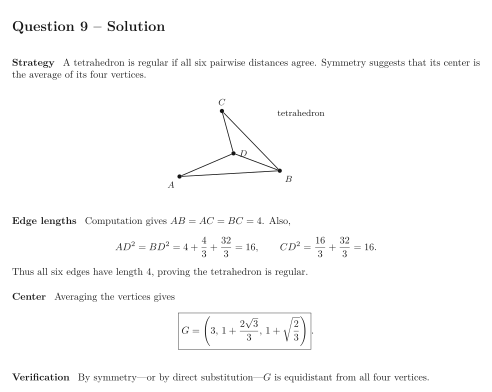
See the diagram in the original worksheet below.

Edge lengths Computation gives AB=AC=BC=4AB=AC=BC=4. Also, AD2=BD2=4+43+323=16,CD2=163+323=16.AD^2=BD^2=4+\frac 43+\frac{32}{3}=16, \qquad CD^2=\frac{16}{3}+\frac{32}{3}=16. Thus all six edges have length 4, proving the tetrahedron is regular.

Center Averaging the vertices gives G=(3,1+233,1+23).\boxed{G=\left(3,\,1+\frac{2\sqrt 3}{3},\,1+\sqrt{\frac 23}\right)}.

Verification By symmetry—or by direct substitution—GG is equidistant from all four vertices.
Original worksheet page 2: question and worked solution for 6-1-009

Original worksheet layout. Use Enlarge or open the PDF for a closer view.