Curvature — Question 1

PDF ↗

Question 1

Starting from r→(t)=⟨acost,asint⟩\vec r(t)=\left\langle a\cos t,a\sin t\right\rangle, where a>0a>0, derive the curvature of a circle. Interpret the result in terms of turning sharpness and radius of curvature.

Original worksheet page 1: question and worked solution for 6-10-001
Show solutionHide solution

Question 1 – Solution

Strategy Use κ=∥r→′×r→″∥/∥r→′∥3\kappa=\|\vec r'\times\vec r''\|/\|\vec r'\|^3, viewing planar vectors as three-dimensional vectors with zero third component.

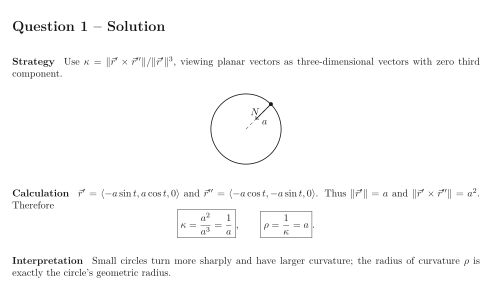
See the diagram in the original worksheet below.

Calculation r→′=⟨−asint,acost,0⟩\vec r'=\left\langle -a\sin t,a\cos t,0\right\rangle and r→″=⟨−acost,−asint,0⟩\vec r''=\left\langle -a\cos t,-a\sin t,0\right\rangle. Thus ∥r→′∥=a\|\vec r'\|=a and ∥r→′×r→″∥=a2\|\vec r'\times\vec r''\|=a^2. Therefore κ=a2a3=1a,ρ=1κ=a.\boxed{\kappa=\frac{a^2}{a^3}=\frac 1a},\qquad \boxed{\rho=\frac 1\kappa=a}.

Interpretation Small circles turn more sharply and have larger curvature; the radius of curvature ρ\rho is exactly the circle’s geometric radius.
Original worksheet page 2: question and worked solution for 6-10-001

Original worksheet layout. Use Enlarge or open the PDF for a closer view.