Velocity and Acceleration — Question 3
Question 3
A particle moves on the circle
,
where
.
Find velocity, acceleration, speed, and show that acceleration points
toward the center with magnitude
.
Show solutionHide solution+
Question 3 –
Solution
Strategy Differentiate twice and compare
acceleration with the position vector.
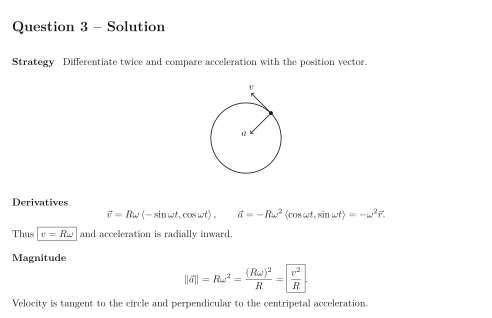
See the diagram in the original worksheet below.
Derivatives
Thus
and acceleration is radially inward.
Magnitude
Velocity is
tangent to the circle and perpendicular to the centripetal
acceleration.
Original worksheet layout. Use Enlarge or open the PDF for a closer view.