Velocity and Acceleration — Question 5

PDF ↗

Question 5

At an instant, a particle has velocity v→=⟨2,1,2⟩\vec v=\left\langle 2,1,2\right\rangle and acceleration a→=⟨1,2,−2⟩\vec a=\left\langle 1,2,-2\right\rangle. Find the scalar tangential and normal components aT,aNa_T,a_N. State what each says about the motion.

Original worksheet page 1: question and worked solution for 6-11-005
Show solutionHide solution

Question 5 – Solution

Strategy Use aT=(v→⋅a→)/∥v→∥a_T=(\vec v\cdot\vec a)/\|\vec v\| and aN=∥a→∥2−aT2a_N=\sqrt{\|\vec a\|^2-a_T^2}.

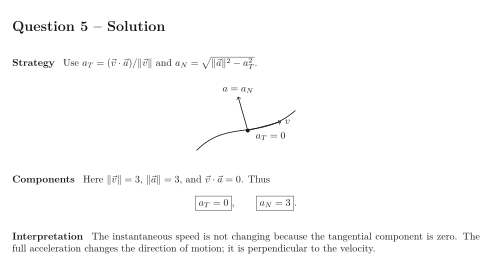
See the diagram in the original worksheet below.

Components Here ∥v→∥=3\|\vec v\|=3, ∥a→∥=3\|\vec a\|=3, and v→⋅a→=0\vec v\cdot\vec a=0. Thus aT=0,aN=3.\boxed{a_T=0},\qquad \boxed{a_N=3}.

Interpretation The instantaneous speed is not changing because the tangential component is zero. The full acceleration changes the direction of motion; it is perpendicular to the velocity.
Original worksheet page 2: question and worked solution for 6-11-005

Original worksheet layout. Use Enlarge or open the PDF for a closer view.