Velocity and Acceleration — Question 8

PDF ↗

Question 8

Particles follow r→1(t)=⟨t,t,0⟩\vec r_1(t)=\left\langle t,t,0\right\rangle and r→2(t)=⟨2−t,t2−1,0⟩\vec r_2(t)=\left\langle 2-t,t^2-1,0\right\rangle. Do their paths intersect? Do the particles collide for t≥0t\ge 0? Clearly distinguish the two questions.

Original worksheet page 1: question and worked solution for 6-11-008
Show solutionHide solution

Question 8 – Solution

Strategy Path intersection may use different parameter values; collision requires equal positions at the same time.

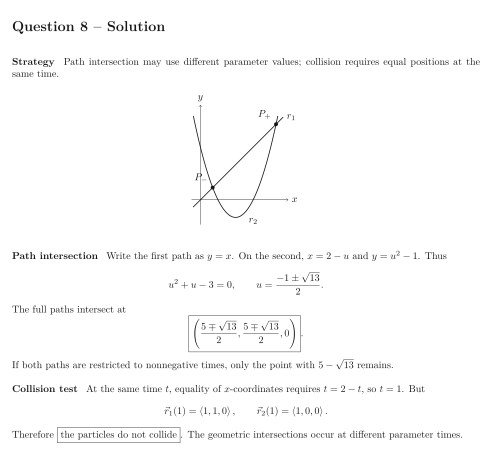
See the diagram in the original worksheet below.

Path intersection Write the first path as y=xy=x. On the second, x=2−ux=2-u and y=u2−1y=u^2-1. Thus u2+u−3=0,u=−1±132.u^2+u-3=0,\qquad u=\frac{-1\pm\sqrt{13}}2. The full paths intersect at (5∓132,5∓132,0).\boxed{\left(\frac{5\mp\sqrt{13}}2,\frac{5\mp\sqrt{13}}2,0\right)}. If both paths are restricted to nonnegative times, only the point with 5−135-\sqrt{13} remains.

Collision test At the same time tt, equality of xx-coordinates requires t=2−tt=2-t, so t=1t=1. But r→1(1)=⟨1,1,0⟩,r→2(1)=⟨1,0,0⟩.\vec r_1(1)=\left\langle 1,1,0\right\rangle,\qquad\vec r_2(1)=\left\langle 1,0,0\right\rangle. Therefore the particles do not collide\boxed{\text{the particles do not collide}}. The geometric intersections occur at different parameter times.
Original worksheet page 2: question and worked solution for 6-11-008

Original worksheet layout. Use Enlarge or open the PDF for a closer view.