Cylindrical Coordinates — Question 8

PDF ↗

Question 8

A moving point has cylindrical coordinates r(t),θ(t),z(t)r(t),\theta(t),z(t). Derive its rectangular velocity and prove that its speed satisfies ∥v→∥2=ṙ2+r2θ̇2+ż2.\|\vec v\|^2=\dot r^{\,2}+r^2\dot\theta^{\,2}+\dot z^{\,2}.

Original worksheet page 1: question and worked solution for 6-12-008
Show solutionHide solution

Question 8 – Solution

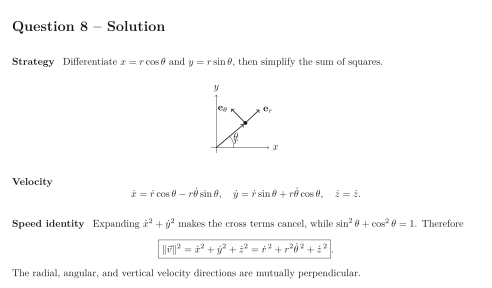
Strategy Differentiate x=rcos⁡θx=r\cos\theta and y=rsin⁡θy=r\sin\theta, then simplify the sum of squares.

See the diagram in the original worksheet below.

Velocity ẋ=ṙcos⁡θ−rθ̇sin⁡θ,ẏ=ṙsin⁡θ+rθ̇cos⁡θ,ż=ż.\dot x=\dot r\cos\theta-r\dot\theta\sin\theta,\quad \dot y=\dot r\sin\theta+r\dot\theta\cos\theta,\quad \dot z=\dot z.

Speed identity Expanding ẋ2+ẏ2\dot x^2+\dot y^2 makes the cross terms cancel, while sin⁡2θ+cos⁡2θ=1\sin^2\theta+\cos^2\theta=1. Therefore ∥v→∥2=ẋ2+ẏ2+ż2=ṙ2+r2θ̇2+ż2.\boxed{\|\vec v\|^2=\dot x^2+\dot y^2+\dot z^2 =\dot r^{\,2}+r^2\dot\theta^{\,2}+\dot z^{\,2}}. The radial, angular, and vertical velocity directions are mutually perpendicular.
Original worksheet page 2: question and worked solution for 6-12-008

Original worksheet layout. Use Enlarge or open the PDF for a closer view.