Question 7
Classify , describe its axis, and find the area of a cross-section perpendicular to that axis. Does the surface intersect the -axis?

Show solutionHide solution
Question 7 – Solution
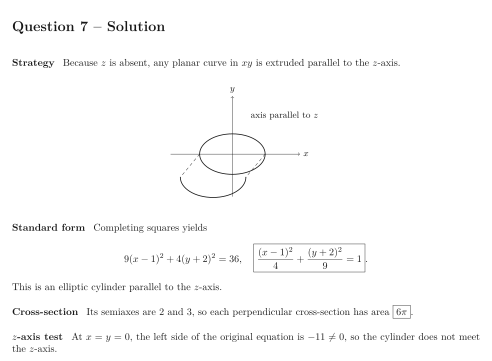
Strategy Because is absent, any planar curve in is extruded parallel to the -axis.
See the diagram in the original worksheet below.
Standard form Completing squares yields This is an elliptic cylinder parallel to the -axis.
Cross-section Its semiaxes are 2 and 3, so each perpendicular cross-section has area .
-axis test At , the left side of the original equation is , so the cylinder does not meet the -axis.