Vector Functions — Question 1

PDF ↗

Question 1

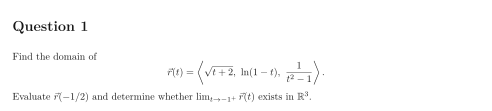
Find the domain of r→(t)=⟨t+2,ln(1−t),1t2−1⟩.\vec r(t)=\left\langle\sqrt{t+2},\ \ln(1-t),\ \frac 1{t^2-1}\right\rangle. Evaluate r→(−1/2)\vec r(-1/2) and determine whether lim⁡t→−1+r→(t)\lim_{t\to-1^+}\vec r(t) exists in ℝ3\mathbb R^3.

Original worksheet page 1: question and worked solution for 6-6-001
Show solutionHide solution

Question 1 – Solution

Strategy Intersect the domains of all three scalar components; vector limits exist exactly when every component limit is finite.

See the diagram in the original worksheet below.

Domain The restrictions are t≥−2t\ge-2, t<1t<1, and t≠±1t\ne\pm 1. Hence [−2,−1)∪(−1,1).\boxed{[-2,-1)\cup(-1,1)}. Also r→(−1/2)=⟨3/2,ln(3/2),−4/3⟩\vec r(-1/2)=\left\langle\sqrt{3/2},\ln(3/2),-4/3\right\rangle.

Limit As t→−1+t\to-1^+, 1/(t2−1)→−∞1/(t^2-1)\to-\infty, so no finite vector limit exists in ℝ3\mathbb R^3.

Original worksheet page 2: question and worked solution for 6-6-001

Original worksheet layout. Use Enlarge or open the PDF for a closer view.