Vector Functions — Question 5

PDF ↗

Question 5

Construct a vector function that travels from A=(−2,1,4)A=(-2,1,4) to B=(3,−1,0)B=(3,-1,0) during 0≤t≤10\le t\le 1, but does so nonuniformly: it starts and ends at rest while remaining on the line segment.

Original worksheet page 1: question and worked solution for 6-6-005
Show solutionHide solution

Question 5 – Solution

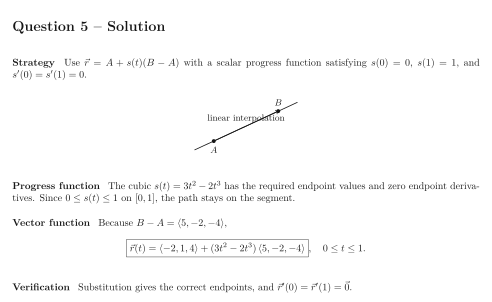
Strategy Use r→=A+s(t)(B−A)\vec r=A+s(t)(B-A) with a scalar progress function satisfying s(0)=0s(0)=0, s(1)=1s(1)=1, and s′(0)=s′(1)=0s'(0)=s'(1)=0.

See the diagram in the original worksheet below.

Progress function The cubic s(t)=3t2−2t3s(t)=3t^2-2t^3 has the required endpoint values and zero endpoint derivatives. Since 0≤s(t)≤10\le s(t)\le 1 on [0,1][0,1], the path stays on the segment.

Vector function Because B−A=⟨5,−2,−4⟩B-A=\left\langle 5,-2,-4\right\rangle, r→(t)=⟨−2,1,4⟩+(3t2−2t3)⟨5,−2,−4⟩,0≤t≤1.\boxed{\vec r(t)=\left\langle-2,1,4\right\rangle+(3t^2-2t^3)\left\langle 5,-2,-4\right\rangle},\quad 0\le t\le 1.

Verification Substitution gives the correct endpoints, and r→′(0)=r→′(1)=0→\vec r'(0)=\vec r'(1)=\vec 0.

Original worksheet page 2: question and worked solution for 6-6-005

Original worksheet layout. Use Enlarge or open the PDF for a closer view.