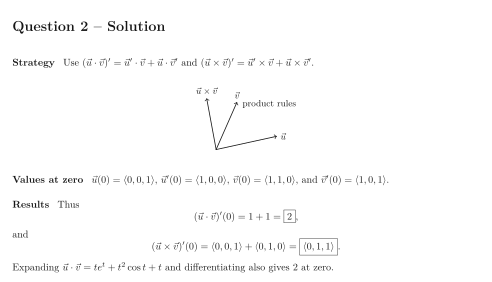
Question 2 Let u→(t)=⟨t,t2,1⟩\vec u(t)=\left\langle t,t^2,1\right\rangle and v→(t)=⟨et,cost,t⟩\vec v(t)=\left\langle e^t,\cos t,t\right\rangle. Compute ddt(u→⋅v→)\frac d{dt}(\vec u\cdot\vec v) and ddt(u→×v→)\frac d{dt}(\vec u\times\vec v) at t=0t=0 using product rules, then verify the dot-product result by expanding first. Show solutionHide solution+Question 2 – Solution Strategy Use (u→⋅v→)′=u→′⋅v→+u→⋅v→′(\vec u\cdot\vec v)'=\vec u'\cdot\vec v+\vec u\cdot\vec v' and (u→×v→)′=u→′×v→+u→×v→′(\vec u\times\vec v)'=\vec u'\times\vec v+\vec u\times\vec v'. See the diagram in the original worksheet below. Values at zero u→(0)=⟨0,0,1⟩\vec u(0)=\left\langle 0,0,1\right\rangle, u→′(0)=⟨1,0,0⟩\vec u'(0)=\left\langle 1,0,0\right\rangle, v→(0)=⟨1,1,0⟩\vec v(0)=\left\langle 1,1,0\right\rangle, and v→′(0)=⟨1,0,1⟩\vec v'(0)=\left\langle 1,0,1\right\rangle. Results Thus (u→⋅v→)′(0)=1+1=2,(\vec u\cdot\vec v)'(0)=1+1=\boxed 2, and (u→×v→)′(0)=⟨0,0,1⟩+⟨0,1,0⟩=⟨0,1,1⟩.(\vec u\times\vec v)'(0)=\left\langle 0,0,1\right\rangle+\left\langle 0,1,0\right\rangle=\boxed{\left\langle 0,1,1\right\rangle}. Expanding u→⋅v→=tet+t2cost+t\vec u\cdot\vec v=te^t+t^2\cos t+t and differentiating also gives 2 at zero.