Calculus with Vector Functions — Question 5

PDF ↗

Question 5

Suppose a differentiable vector function satisfies ∥r→(t)∥=5\|\vec r(t)\|=5 for every tt. Prove that r→(t)⟂r→′(t)\vec r(t)\perp\vec r'(t). Apply the result to r→(t)=⟨3cost,3sint,4⟩\vec r(t)=\left\langle 3\cos t,3\sin t,4\right\rangle and verify directly.

Original worksheet page 1: question and worked solution for 6-7-005
Show solutionHide solution

Question 5 – Solution

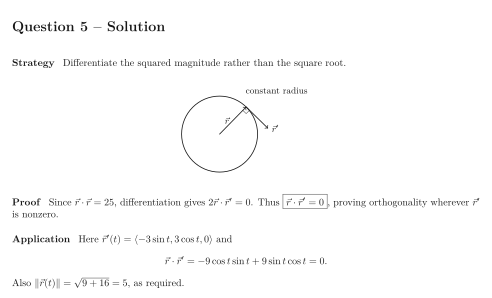
Strategy Differentiate the squared magnitude rather than the square root.

See the diagram in the original worksheet below.

Proof Since r→⋅r→=25\vec r\cdot\vec r=25, differentiation gives 2r→⋅r→′=02\vec r\cdot\vec r'=0. Thus r→⋅r→′=0\boxed{\vec r\cdot\vec r'=0}, proving orthogonality wherever r→′\vec r' is nonzero.

Application Here r→′(t)=⟨−3sint,3cost,0⟩\vec r'(t)=\left\langle-3\sin t,3\cos t,0\right\rangle and r→⋅r→′=−9cos⁡tsin⁡t+9sin⁡tcos⁡t=0.\vec r\cdot\vec r'=-9\cos t\sin t+9\sin t\cos t=0. Also ∥r→(t)∥=9+16=5\|\vec r(t)\|=\sqrt{9+16}=5, as required.

Original worksheet page 2: question and worked solution for 6-7-005

Original worksheet layout. Use Enlarge or open the PDF for a closer view.