Calculus with Vector Functions — Question 8

PDF ↗

Question 8

For r→(t)=⟨cost,sint,et⟩\vec r(t)=\left\langle\cos t,\sin t,e^t\right\rangle, form the second-order Taylor approximation about t=0t=0. Use it to approximate r→(0.05)\vec r(0.05) and state the order of the neglected error.

Original worksheet page 1: question and worked solution for 6-7-008
Show solutionHide solution

Question 8 – Solution

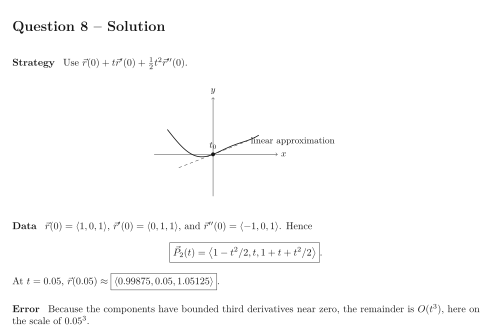
Strategy Use r→(0)+tr→′(0)+12t2r→″(0)\vec r(0)+t\vec r'(0)+\frac 12t^2\vec r''(0).

See the diagram in the original worksheet below.

Data r→(0)=⟨1,0,1⟩\vec r(0)=\left\langle 1,0,1\right\rangle, r→′(0)=⟨0,1,1⟩\vec r'(0)=\left\langle 0,1,1\right\rangle, and r→″(0)=⟨−1,0,1⟩\vec r''(0)=\left\langle-1,0,1\right\rangle. Hence P→2(t)=⟨1−t2/2,t,1+t+t2/2⟩.\boxed{\vec P_2(t)=\left\langle 1-t^2/2,t,1+t+t^2/2\right\rangle}. At t=0.05t=0.05, r→(0.05)≈⟨0.99875,0.05,1.05125⟩\vec r(0.05)\approx\boxed{\left\langle 0.99875,0.05,1.05125\right\rangle}.

Error Because the components have bounded third derivatives near zero, the remainder is O(t3)O(t^3), here on the scale of 0.0530.05^3.

Original worksheet page 2: question and worked solution for 6-7-008

Original worksheet layout. Use Enlarge or open the PDF for a closer view.