Arc Length with Vector Functions — Question 7

PDF ↗

Question 7

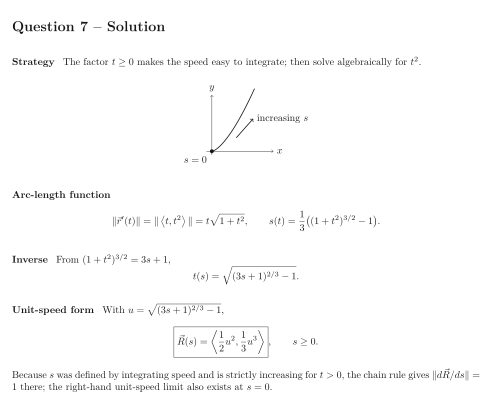
For t≥0t\ge 0, let r→(t)=⟨12t2,13t3⟩\vec r(t)=\left\langle \frac 12t^2,\frac 13t^3\right\rangle. Construct the arc-length coordinate measured from t=0t=0, invert it explicitly, and give a unit-speed parameterization R→(s)\vec R(s).

Original worksheet page 1: question and worked solution for 6-9-007
Show solutionHide solution

Question 7 – Solution

Strategy The factor t≥0t\ge 0 makes the speed easy to integrate; then solve algebraically for t2t^2.

See the diagram in the original worksheet below.

Arc-length function ∥r→′(t)∥=∥⟨t,t2⟩∥=t1+t2,s(t)=13((1+t2)3/2−1).\|\vec r'(t)\|=\|\left\langle t,t^2\right\rangle\|=t\sqrt{1+t^2},\qquad s(t)=\frac 13\bigl((1+t^2)^{3/2}-1\bigr).

Inverse From (1+t2)3/2=3s+1(1+t^2)^{3/2}=3s+1, t(s)=(3s+1)2/3−1.t(s)=\sqrt{(3s+1)^{2/3}-1}.

Unit-speed form With u=(3s+1)2/3−1u=\sqrt{(3s+1)^{2/3}-1}, R→(s)=⟨12u2,13u3⟩,s≥0.\boxed{\vec R(s)=\left\langle \frac 12u^2,\frac 13u^3\right\rangle},\qquad s\ge 0. Because ss was defined by integrating speed and is strictly increasing for t>0t>0, the chain rule gives ∥dR→/ds∥=1\|d\vec R/ds\|=1 there; the right-hand unit-speed limit also exists at s=0s=0.

Original worksheet page 2: question and worked solution for 6-9-007

Original worksheet layout. Use Enlarge or open the PDF for a closer view.