Arc Length with Vector Functions — Question 8

PDF ↗

Question 8

Suppose q→(u)=r→(ϕ(u))\vec q(u)=\vec r(\phi(u)) traces the same regular curve, where ϕ\phi is continuously differentiable and strictly monotone. Prove that the arc length is unchanged by this reparameterization, including the case in which orientation is reversed.

Original worksheet page 1: question and worked solution for 6-9-008
Show solutionHide solution

Question 8 – Solution

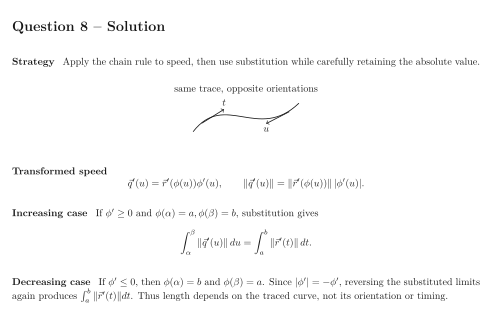
Strategy Apply the chain rule to speed, then use substitution while carefully retaining the absolute value.

See the diagram in the original worksheet below.

Transformed speed q→′(u)=r→′(ϕ(u))ϕ′(u),∥q→′(u)∥=∥r→′(ϕ(u))∥|ϕ′(u)|.\vec q'(u)=\vec r'(\phi(u))\phi'(u),\qquad \|\vec q'(u)\|=\|\vec r'(\phi(u))\|\,|\phi'(u)|.

Increasing case If ϕ′≥0\phi'\ge 0 and ϕ(α)=a,ϕ(β)=b\phi(\alpha)=a,\phi(\beta)=b, substitution gives ∫αβ∥q→′(u)∥du=∫ab∥r→′(t)∥dt.\int_\alpha^\beta\|\vec q'(u)\|\,du=\int_a^b\|\vec r'(t)\|\,dt.

Decreasing case If ϕ′≤0\phi'\le 0, then ϕ(α)=b\phi(\alpha)=b and ϕ(β)=a\phi(\beta)=a. Since |ϕ′|=−ϕ′|\phi'|=-\phi', reversing the substituted limits again produces ∫ab∥r→′(t)∥dt\int_a^b\|\vec r'(t)\|dt. Thus length depends on the traced curve, not its orientation or timing.
Original worksheet page 2: question and worked solution for 6-9-008

Original worksheet layout. Use Enlarge or open the PDF for a closer view.