Question 5
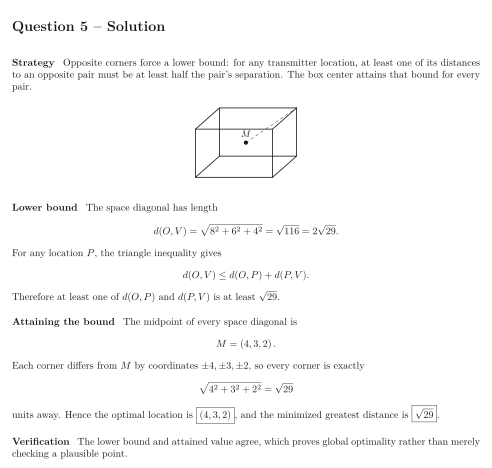
A rectangular laboratory is aligned with the coordinate axes and has opposite corners A wireless transmitter will be installed at a point inside the laboratory. Define
Design objective
Find the location of that minimizes .
Find the minimum possible value of .
Prove that no other transmitter location can produce a smaller greatest distance.
Show solutionHide solution
Question 5 – Solution
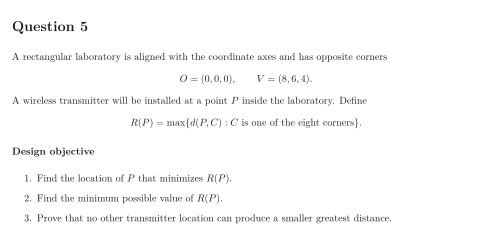
Strategy Opposite corners force a lower bound: for any transmitter location, at least one of its distances to an opposite pair must be at least half the pair’s separation. The box center attains that bound for every pair.
See the diagram in the original worksheet below.
Lower bound The space diagonal has length For any location , the triangle inequality gives Therefore at least one of and is at least .
Attaining the bound The midpoint of every space diagonal is Each corner differs from by coordinates , so every corner is exactly units away. Hence the optimal location is , and the minimized greatest distance is .
Verification The lower bound and attained value agree, which proves global optimality rather than merely checking a plausible point.