Question 8
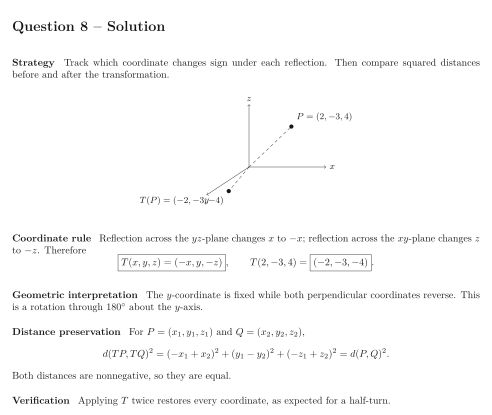
A transformation is performed in this order:
reflect across the -plane;
then reflect the result across the -plane.
Tasks
Find a coordinate formula for .
Compute .
Identify the single rigid motion equivalent to this composition.
Prove directly from the three-dimensional distance formula that preserves the distance between every pair of points.
Show solutionHide solution
Question 8 – Solution
Strategy Track which coordinate changes sign under each reflection. Then compare squared distances before and after the transformation.
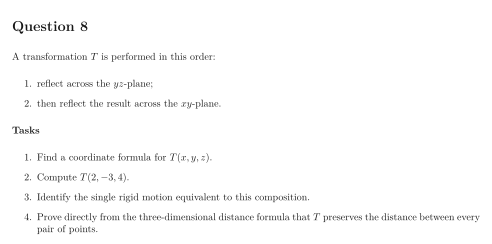
See the diagram in the original worksheet below.
Coordinate rule Reflection across the -plane changes to ; reflection across the -plane changes to . Therefore
Geometric interpretation The -coordinate is fixed while both perpendicular coordinates reverse. This is a rotation through about the -axis.
Distance preservation For and , Both distances are nonnegative, so they are equal.
Verification Applying twice restores every coordinate, as expected for a half-turn.