Question 10
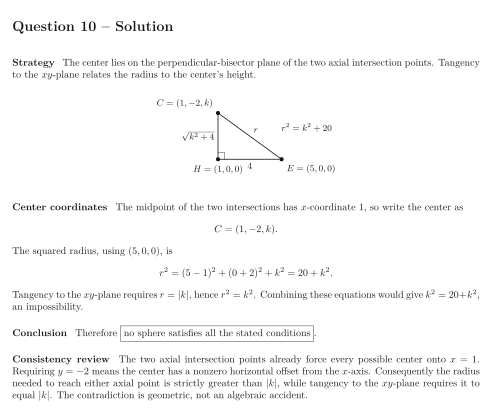
A proposed sphere is required to satisfy all three conditions below:
It intersects the -axis at
Its center lies in the plane .
It is tangent to the -plane.
Consistency test
Determine whether such a sphere exists. If it does, find every possible center, radius, and equation. If it does not, prove precisely which requirements are incompatible.
Show solutionHide solution
Question 10 – Solution
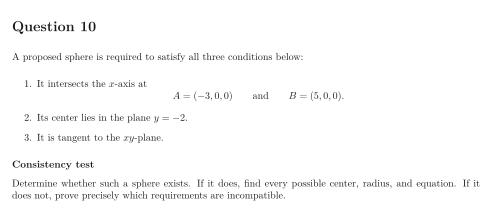
Strategy The center lies on the perpendicular-bisector plane of the two axial intersection points. Tangency to the -plane relates the radius to the center’s height.
See the diagram in the original worksheet below.
Center coordinates The midpoint of the two intersections has -coordinate , so write the center as The squared radius, using , is Tangency to the -plane requires , hence . Combining these equations would give , an impossibility.
Conclusion Therefore .
Consistency review The two axial intersection points already force every possible center onto . Requiring means the center has a nonzero horizontal offset from the -axis. Consequently the radius needed to reach either axial point is strictly greater than , while tangency to the -plane requires it to equal . The contradiction is geometric, not an algebraic accident.