Velocity and Acceleration — Question 2

PDF ↗

Question 2

A ball is launched from (0,0,5)(0,0,5) with initial velocity ⟨30,40,50⟩\left\langle 30,40,50\right\rangle ft/s. Gravity is ⟨0,0,−32⟩\left\langle 0,0,-32\right\rangle ft/s2^2 and air resistance is neglected.

Tasks

  1. Find position and velocity for t≥0t\ge 0.

  2. Find the maximum height and when it occurs.

  3. Find the landing time and horizontal landing point.
Original worksheet page 1: question and worked solution for 1-11-002
Show solutionHide solution

Question 2 – Solution

Strategy. Integrate constant acceleration twice and apply the initial data; landing occurs when the vertical coordinate is zero.

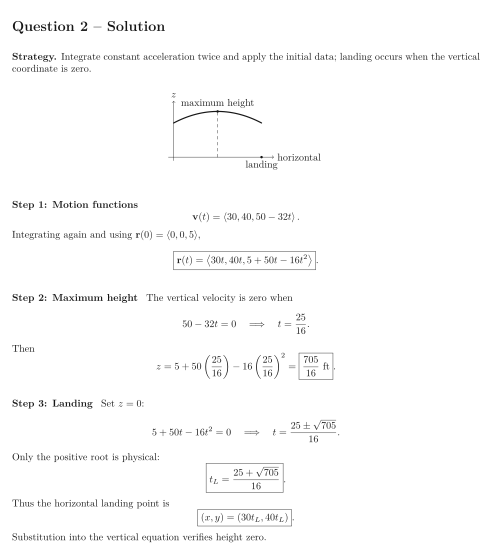
See the diagram in the original worksheet below.

Step 1: Motion functions 𝒗(t)=⟨30,40,50−32t⟩.\mathbf v(t)=\left\langle 30,40,50-32t\right\rangle. Integrating again and using 𝒓(0)=⟨0,0,5⟩\mathbf r(0)=\left\langle 0,0,5\right\rangle, 𝒓(t)=⟨30t,40t,5+50t−16t2⟩.\boxed{\mathbf r(t)=\left\langle 30t,40t,5+50t-16t^2\right\rangle}.

Step 2: Maximum height The vertical velocity is zero when 50−32t=0⇒t=2516.50-32t=0\quad\Longrightarrow\quad t=\frac{25}{16}. Then z=5+50(2516)−16(2516)2=70516 ft.z=5+50\left(\frac{25}{16}\right)-16\left(\frac{25}{16}\right)^2 =\boxed{\frac{705}{16}\text{ ft}}.

Step 3: Landing Set z=0z=0: 5+50t−16t2=0⇒t=25±70516.5+50t-16t^2=0 \quad\Longrightarrow\quad t=\frac{25\pm\sqrt{705}}{16}. Only the positive root is physical: tL=25+70516.\boxed{t_L=\frac{25+\sqrt{705}}{16}}. Thus the horizontal landing point is (x,y)=(30tL,40tL).\boxed{(x,y)=\left(30t_L,40t_L\right)}. Substitution into the vertical equation verifies height zero.
Original worksheet page 2: question and worked solution for 1-11-002

Original worksheet layout. Use Enlarge or open the PDF for a closer view.