Velocity and Acceleration β€” Question 5

PDF β†—

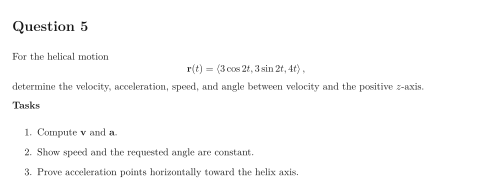
Question 5

For the helical motion 𝒓(t)=⟨3cos2t,3sin2t,4t⟩,\mathbf r(t)=\left\langle 3\cos 2t,3\sin 2t,4t\right\rangle, determine the velocity, acceleration, speed, and angle between velocity and the positive zz-axis.

Tasks

  1. Compute 𝒗\mathbf v and 𝒂\mathbf a.

  2. Show speed and the requested angle are constant.

  3. Prove acceleration points horizontally toward the helix axis.
Original worksheet page 1: question and worked solution for 1-11-005
Show solutionHide solution

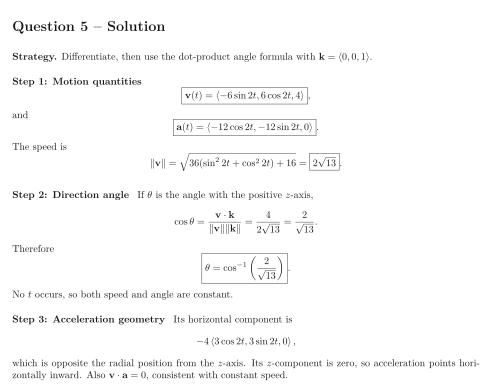
Question 5 – Solution

Strategy. Differentiate, then use the dot-product angle formula with π’Œ=⟨0,0,1⟩\mathbf k=\left\langle 0,0,1\right\rangle.

Step 1: Motion quantities 𝒗(t)=βŸ¨βˆ’6sin2t,6cos2t,4⟩,\boxed{\mathbf v(t)=\left\langle -6\sin 2t,6\cos 2t,4\right\rangle}, and 𝒂(t)=βŸ¨βˆ’12cos2t,βˆ’12sin2t,0⟩.\boxed{\mathbf a(t)=\left\langle -12\cos 2t,-12\sin 2t,0\right\rangle}. The speed is βˆ₯𝒗βˆ₯=36(sin⁡22t+cos⁡22t)+16=213.\|\mathbf v\|=\sqrt{36(\sin^22t+\cos^22t)+16} =\boxed{2\sqrt{13}}.

Step 2: Direction angle If ΞΈ\theta is the angle with the positive zz-axis, cos⁡ΞΈ=π’—β‹…π’Œβˆ₯𝒗βˆ₯βˆ₯π’Œβˆ₯=4213=213.\cos\theta=\frac{\mathbf v\cdot\mathbf k}{\|\mathbf v\|\|\mathbf k\|} =\frac 4{2\sqrt{13}}=\frac 2{\sqrt{13}}. Therefore ΞΈ=cos⁡βˆ’1(213).\boxed{\theta=\cos^{-1}\left(\frac 2{\sqrt{13}}\right)}. No tt occurs, so both speed and angle are constant.

Step 3: Acceleration geometry Its horizontal component is βˆ’4⟨3cos2t,3sin2t,0⟩,-4\left\langle 3\cos 2t,3\sin 2t,0\right\rangle, which is opposite the radial position from the zz-axis. Its zz-component is zero, so acceleration points horizontally inward. Also 𝒗⋅𝒂=0\mathbf v\cdot\mathbf a=0, consistent with constant speed.

Original worksheet page 2: question and worked solution for 1-11-005

Original worksheet layout. Use Enlarge or open the PDF for a closer view.