Velocity and Acceleration β€” Question 7

PDF β†—

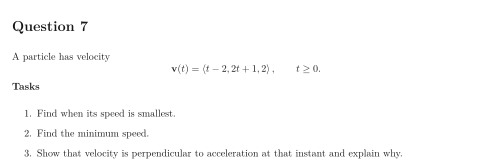
Question 7

A particle has velocity 𝒗(t)=⟨tβˆ’2,2t+1,2⟩,tβ‰₯0.\mathbf v(t)=\left\langle t-2,2t+1,2\right\rangle,\qquad t\ge 0. Tasks

  1. Find when its speed is smallest.

  2. Find the minimum speed.

  3. Show that velocity is perpendicular to acceleration at that instant and explain why.
Original worksheet page 1: question and worked solution for 1-11-007
Show solutionHide solution

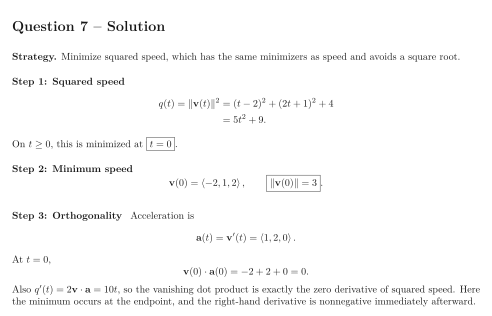
Question 7 – Solution

Strategy. Minimize squared speed, which has the same minimizers as speed and avoids a square root.

Step 1: Squared speed q(t)=βˆ₯𝒗(t)βˆ₯2=(tβˆ’2)2+(2t+1)2+4=5t2+9.\begin{align*} q(t)=\|\mathbf v(t)\|^2 &=(t-2)^2+(2t+1)^2+4\\ &=5t^2+9. \end{align*} On tβ‰₯0t\ge 0, this is minimized at t=0\boxed{t=0}.

Step 2: Minimum speed 𝒗(0)=βŸ¨βˆ’2,1,2⟩,βˆ₯𝒗(0)βˆ₯=3.\mathbf v(0)=\left\langle -2,1,2\right\rangle, \qquad \boxed{\|\mathbf v(0)\|=3}.

Step 3: Orthogonality Acceleration is 𝒂(t)=𝒗′(t)=⟨1,2,0⟩.\mathbf a(t)=\mathbf v'(t)=\left\langle 1,2,0\right\rangle. At t=0t=0, 𝒗(0)⋅𝒂(0)=βˆ’2+2+0=0.\mathbf v(0)\cdot\mathbf a(0)=-2+2+0=0. Also qβ€²(t)=2𝒗⋅𝒂=10tq'(t)=2\mathbf v\cdot\mathbf a=10t, so the vanishing dot product is exactly the zero derivative of squared speed. Here the minimum occurs at the endpoint, and the right-hand derivative is nonnegative immediately afterward.
Original worksheet page 2: question and worked solution for 1-11-007

Original worksheet layout. Use Enlarge or open the PDF for a closer view.