Velocity and Acceleration β€” Question 10

PDF β†—

Question 10

Let a regular motion have velocity 𝒗\mathbf v, speed v=βˆ₯𝒗βˆ₯v=\|\mathbf v\|, unit tangent 𝑻\mathbf T, curvature ΞΊ\kappa, and principal normal 𝑡\mathbf N.

Tasks

  1. Derive 𝒂=v′𝑻+ΞΊv2𝑡\mathbf a=v'\mathbf T+\kappa v^2\mathbf N.

  2. Derive formulas for the tangential and normal scalar components using only 𝒗\mathbf v and 𝒂\mathbf a.

  3. Explain the physical meaning of each component.
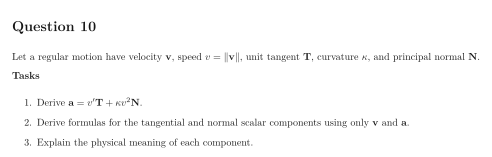
Original worksheet page 1: question and worked solution for 1-11-010
Show solutionHide solution

Question 10 – Solution

Strategy. Begin with 𝒗=v𝑻\mathbf v=v\mathbf T, differentiate, and convert d𝑻/dtd\mathbf T/dt through arc length.

Step 1: Differentiate velocity 𝒂=ddt(v𝑻)=v′𝑻+vd𝑻dt.\mathbf a=\frac d{dt}(v\mathbf T)=v'\mathbf T+v\frac{d\mathbf T}{dt}. By the chain rule, d𝑻dt=d𝑻dsdsdt=(κ𝑡)v.\frac{d\mathbf T}{dt}=\frac{d\mathbf T}{ds}\frac{ds}{dt} =(\kappa\mathbf N)v. Therefore 𝒂=v′𝑻+ΞΊv2𝑡.\boxed{\mathbf a=v'\mathbf T+\kappa v^2\mathbf N}.

Step 2: Tangential component Dot with 𝑻=𝒗/v\mathbf T=\mathbf v/v: aT=𝒂⋅𝑻=𝒗⋅𝒂βˆ₯𝒗βˆ₯.a_T=\mathbf a\cdot\mathbf T =\boxed{\frac{\mathbf v\cdot\mathbf a}{\|\mathbf v\|}}. It also equals vβ€²v', the rate of change of speed.

Step 3: Normal component Orthogonality gives βˆ₯𝒂βˆ₯2=aT2+aN2.\|\mathbf a\|^2=a_T^2+a_N^2. Thus aN=βˆ₯𝒂βˆ₯2βˆ’aT2=βˆ₯𝒗×𝒂βˆ₯βˆ₯𝒗βˆ₯=ΞΊv2.\boxed{a_N=\sqrt{\|\mathbf a\|^2-a_T^2}} =\boxed{\frac{\|\mathbf v\times\mathbf a\|}{\|\mathbf v\|}} =\kappa v^2. The tangential component changes speed; the normal component changes direction. A motion can therefore accelerate even at constant speed if its path bends.
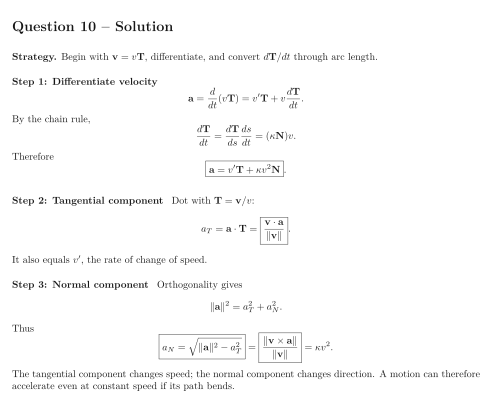
Original worksheet page 2: question and worked solution for 1-11-010

Original worksheet layout. Use Enlarge or open the PDF for a closer view.