Cylindrical Coordinates — Question 1

PDF ↗

Question 1

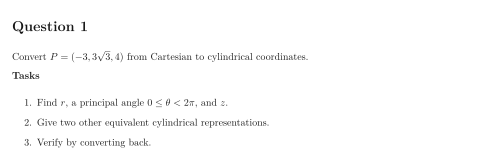
Convert P=(−3,33,4)P=(-3,3\sqrt 3,4) from Cartesian to cylindrical coordinates.

Tasks

  1. Find rr, a principal angle 0≤θ<2π0\le\theta<2\pi, and zz.

  2. Give two other equivalent cylindrical representations.

  3. Verify by converting back.

Original worksheet page 1: question and worked solution for 1-12-001
Show solutionHide solution

Question 1 – Solution

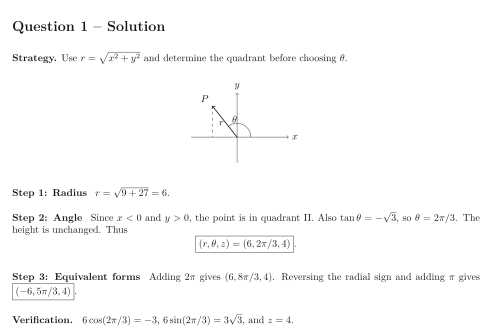
Strategy. Use r=x2+y2r=\sqrt{x^2+y^2} and determine the quadrant before choosing θ\theta.

See the diagram in the original worksheet below.

Step 1: Radius r=9+27=6r=\sqrt{9+27}=6.

Step 2: Angle Since x<0x<0 and y>0y>0, the point is in quadrant II. Also tan⁡θ=−3\tan\theta=-\sqrt 3, so θ=2π/3\theta=2\pi/3. The height is unchanged. Thus (r,θ,z)=(6,2π/3,4).\boxed{(r,\theta,z)=(6,2\pi/3,4)}.

Step 3: Equivalent forms Adding 2π2\pi gives (6,8π/3,4)(6,8\pi/3,4). Reversing the radial sign and adding π\pi gives (−6,5π/3,4)\boxed{(-6,5\pi/3,4)}.

Verification. 6cos⁡(2π/3)=−36\cos(2\pi/3)=-3, 6sin⁡(2π/3)=336\sin(2\pi/3)=3\sqrt 3, and z=4z=4.

Original worksheet page 2: question and worked solution for 1-12-001

Original worksheet layout. Use Enlarge or open the PDF for a closer view.