Question 6
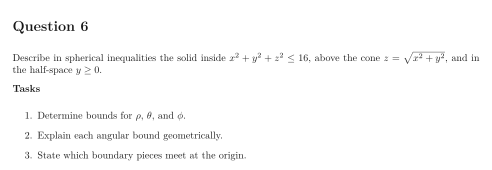
Describe in spherical inequalities the solid inside , above the cone , and in the half-space .
Tasks
Determine bounds for , , and .
Explain each angular bound geometrically.
State which boundary pieces meet at the origin.
Show solutionHide solution
Question 6 – Solution
Strategy. Translate the sphere to a radial bound, the half-space to azimuth, and compare with the cylindrical radius to bound inclination.
See the diagram in the original worksheet below.
Step 1: Radial bound The sphere gives .
Step 2: Azimuth Since and , is represented without overlap by .
Step 3: Inclination Above the cone means For this gives . Consequently The sphere is the outer boundary; the cone and the two half-plane faces all meet at the origin. Angular multiplicity there does not duplicate physical volume.
