Question 8
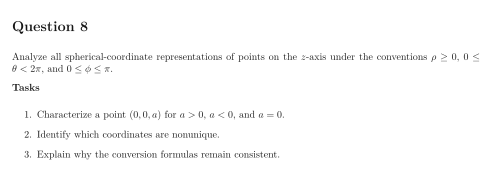
Analyze all spherical-coordinate representations of points on the -axis under the conventions , , and .
Tasks
Characterize a point for , , and .
Identify which coordinates are nonunique.
Explain why the conversion formulas remain consistent.
Show solutionHide solution
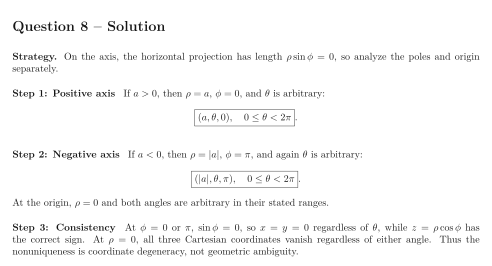
Question 8 – Solution
Strategy. On the axis, the horizontal projection has length , so analyze the poles and origin separately.
Step 1: Positive axis If , then , , and is arbitrary:
Step 2: Negative axis If , then , , and again is arbitrary: At the origin, and both angles are arbitrary in their stated ranges.
Step 3: Consistency At or , , so regardless of , while has the correct sign. At , all three Cartesian coordinates vanish regardless of either angle. Thus the nonuniqueness is coordinate degeneracy, not geometric ambiguity.