Question 10
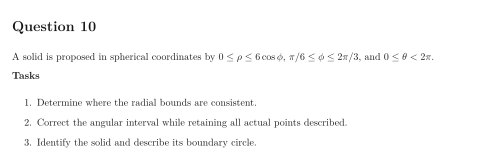
A solid is proposed in spherical coordinates by , , and .
Tasks
Determine where the radial bounds are consistent.
Correct the angular interval while retaining all actual points described.
Identify the solid and describe its boundary circle.
Show solutionHide solution
Question 10 – Solution
Strategy. A nonnegative radial variable can lie below only when that upper bound is nonnegative.
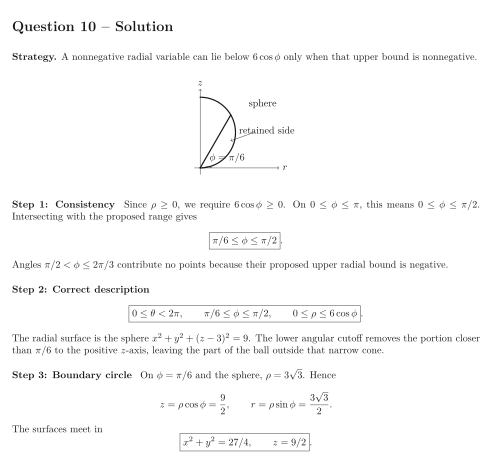
See the diagram in the original worksheet below.
Step 1: Consistency Since , we require . On , this means . Intersecting with the proposed range gives Angles contribute no points because their proposed upper radial bound is negative.
Step 2: Correct description The radial surface is the sphere . The lower angular cutoff removes the portion closer than to the positive -axis, leaving the part of the ball outside that narrow cone.
Step 3: Boundary circle On and the sphere, . Hence The surfaces meet in