Equations of Lines — Question 6

PDF ↗

Question 6

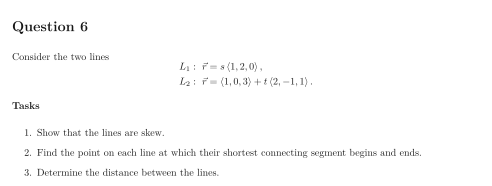
Consider the two lines L1:r→=s⟨1,2,0⟩,L2:r→=⟨1,0,3⟩+t⟨2,−1,1⟩.\begin{aligned} L_1&:\ \vec r=s\left\langle 1,2,0\right\rangle,\\ L_2&:\ \vec r=\left\langle 1,0,3\right\rangle+t\left\langle 2,-1,1\right\rangle. \end{aligned}

Tasks

  1. Show that the lines are skew.

  2. Find the point on each line at which their shortest connecting segment begins and ends.

  3. Determine the distance between the lines.
Original worksheet page 1: question and worked solution for 1-2-006
Show solutionHide solution

Question 6 – Solution

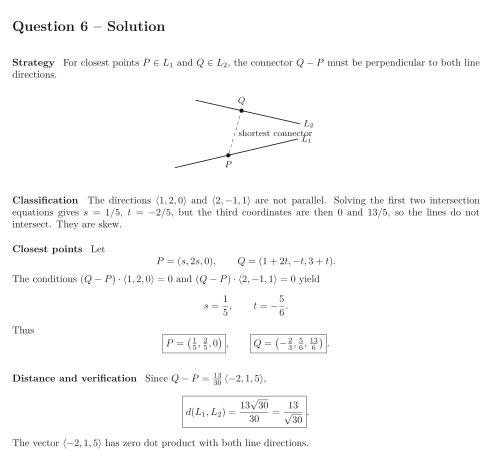
Strategy For closest points P∈L1P\in L_1 and Q∈L2Q\in L_2, the connector Q−PQ-P must be perpendicular to both line directions.

See the diagram in the original worksheet below.

Classification The directions ⟨1,2,0⟩\left\langle 1,2,0\right\rangle and ⟨2,−1,1⟩\left\langle 2,-1,1\right\rangle are not parallel. Solving the first two intersection equations gives s=1/5s=1/5, t=−2/5t=-2/5, but the third coordinates are then 00 and 13/513/5, so the lines do not intersect. They are skew.

Closest points Let P=(s,2s,0),Q=(1+2t,−t,3+t).P=(s,2s,0),\qquad Q=(1+2t,-t,3+t). The conditions (Q−P)⋅⟨1,2,0⟩=0(Q-P)\cdot\left\langle 1,2,0\right\rangle=0 and (Q−P)⋅⟨2,−1,1⟩=0(Q-P)\cdot\left\langle 2,-1,1\right\rangle=0 yield s=15,t=−56.s=\frac 15,\qquad t=-\frac 56. Thus P=(15,25,0),Q=(−23,56,136).\boxed{P=\left(\tfrac 15,\tfrac 25,0\right)},\qquad \boxed{Q=\left(-\tfrac 23,\tfrac 56,\tfrac{13}{6}\right)}.

Distance and verification Since Q−P=1330⟨−2,1,5⟩Q-P=\tfrac{13}{30}\left\langle -2,1,5\right\rangle, d(L1,L2)=133030=1330.\boxed{d(L_1,L_2)=\frac{13\sqrt{30}}{30}=\frac{13}{\sqrt{30}}}. The vector ⟨−2,1,5⟩\left\langle -2,1,5\right\rangle has zero dot product with both line directions.
Original worksheet page 2: question and worked solution for 1-2-006

Original worksheet layout. Use Enlarge or open the PDF for a closer view.