Equations of Lines — Question 8

PDF ↗

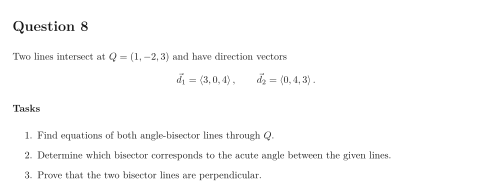
Question 8

Two lines intersect at Q=(1,−2,3)Q=(1,-2,3) and have direction vectors d→1=⟨3,0,4⟩,d→2=⟨0,4,3⟩.\vec d_1=\left\langle 3,0,4\right\rangle,\qquad \vec d_2=\left\langle 0,4,3\right\rangle.

Tasks

  1. Find equations of both angle-bisector lines through QQ.

  2. Determine which bisector corresponds to the acute angle between the given lines.

  3. Prove that the two bisector lines are perpendicular.
Original worksheet page 1: question and worked solution for 1-2-008
Show solutionHide solution

Question 8 – Solution

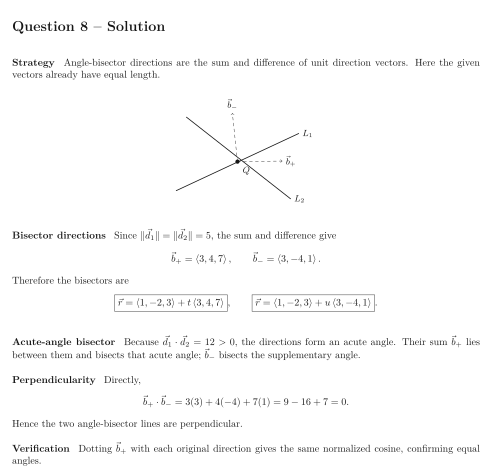
Strategy Angle-bisector directions are the sum and difference of unit direction vectors. Here the given vectors already have equal length.

See the diagram in the original worksheet below.

Bisector directions Since ∥d→1∥=∥d→2∥=5\|\vec d_1\|=\|\vec d_2\|=5, the sum and difference give b→+=⟨3,4,7⟩,b→−=⟨3,−4,1⟩.\vec b_+=\left\langle 3,4,7\right\rangle,\qquad \vec b_-=\left\langle 3,-4,1\right\rangle. Therefore the bisectors are r→=⟨1,−2,3⟩+t⟨3,4,7⟩,r→=⟨1,−2,3⟩+u⟨3,−4,1⟩.\boxed{\vec r=\left\langle 1,-2,3\right\rangle+t\left\langle 3,4,7\right\rangle},\qquad \boxed{\vec r=\left\langle 1,-2,3\right\rangle+u\left\langle 3,-4,1\right\rangle}.

Acute-angle bisector Because d→1⋅d→2=12>0\vec d_1\cdot\vec d_2=12>0, the directions form an acute angle. Their sum b→+\vec b_+ lies between them and bisects that acute angle; b→−\vec b_- bisects the supplementary angle.

Perpendicularity Directly, b→+⋅b→−=3(3)+4(−4)+7(1)=9−16+7=0.\vec b_+\cdot\vec b_-=3(3)+4(-4)+7(1)=9-16+7=0. Hence the two angle-bisector lines are perpendicular.

Verification Dotting b→+\vec b_+ with each original direction gives the same normalized cosine, confirming equal angles.
Original worksheet page 2: question and worked solution for 1-2-008

Original worksheet layout. Use Enlarge or open the PDF for a closer view.