Equations of Planes — Question 2

PDF ↗

Question 2

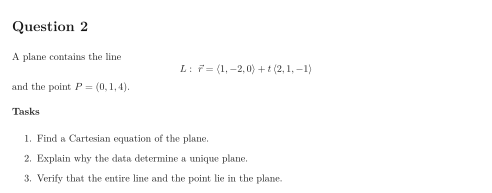
A plane contains the line L:r→=⟨1,−2,0⟩+t⟨2,1,−1⟩L:\ \vec r=\left\langle 1,-2,0\right\rangle+t\left\langle 2,1,-1\right\rangle and the point P=(0,1,4)P=(0,1,4).

Tasks

  1. Find a Cartesian equation of the plane.

  2. Explain why the data determine a unique plane.

  3. Verify that the entire line and the point lie in the plane.
Original worksheet page 1: question and worked solution for 1-3-002
Show solutionHide solution

Question 2 – Solution

Strategy Combine the line direction with a vector from a point on the line to PP. Their cross product is a plane normal.

See the diagram in the original worksheet below.

Step 1: Two directions in the plane Take A=(1,−2,0)A=(1,-2,0) from the line. Its direction is d→=⟨2,1,−1⟩\vec d=\left\langle 2,1,-1\right\rangle, while AP→=P−A=⟨0−1,1−(−2),4−0⟩=⟨−1,3,4⟩.\overrightarrow{AP}=P-A=\left\langle 0-1,1-(-2),4-0\right\rangle=\left\langle -1,3,4\right\rangle.

Step 2: Find a normal Compute d→×AP→=⟨1(4)−(−1)(3),(−1)(−1)−2(4),2(3)−1(−1)⟩=⟨7,−7,7⟩.\vec d\times\overrightarrow{AP} =\left\langle 1(4)-(-1)(3),\ (-1)(-1)-2(4),\ 2(3)-1(-1)\right\rangle =\left\langle 7,-7,7\right\rangle. Thus n→=⟨1,−1,1⟩\vec n=\left\langle 1,-1,1\right\rangle. Using point AA, (x−1)−(y+2)+(z−0)=0,(x-1)-(y+2)+(z-0)=0, so the plane is x−y+z=3.\boxed{x-y+z=3}.

Uniqueness The vectors d→\vec d and AP→\overrightarrow{AP} are not parallel, so they span exactly one plane.

Verification Point PP gives 0−1+4=30-1+4=3. A general point on LL is (1+2t,−2+t,−t)(1+2t,-2+t,-t), and (1+2t)−(−2+t)−t=3(1+2t)-(-2+t)-t=3 for every tt, proving that the whole line is contained in the plane.

Original worksheet page 2: question and worked solution for 1-3-002

Original worksheet layout. Use Enlarge or open the PDF for a closer view.