Equations of Planes — Question 5

PDF ↗

Question 5

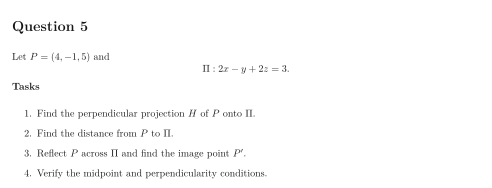
Let P=(4,−1,5)P=(4,-1,5) and Π:2x−y+2z=3.\Pi:2x-y+2z=3. Tasks

  1. Find the perpendicular projection HH of PP onto Π\Pi.

  2. Find the distance from PP to Π\Pi.

  3. Reflect PP across Π\Pi and find the image point P′P'.

  4. Verify the midpoint and perpendicularity conditions.
Original worksheet page 1: question and worked solution for 1-3-005
Show solutionHide solution

Question 5 – Solution

Strategy Move from PP along the normal n→=⟨2,−1,2⟩\vec n=\left\langle 2,-1,2\right\rangle. The signed equation value determines the required multiple.

See the diagram in the original worksheet below.

Step 1: Signed displacement Write the plane as F(x,y,z)=2x−y+2z−3=0F(x,y,z)=2x-y+2z-3=0. At PP, 2(4)−(−1)+2(5)−3=16,∥n→∥2=9.2(4)-(-1)+2(5)-3=16,\qquad \|\vec n\|^2=9.

Step 2: Projection A point on the perpendicular through PP is P−sn→P-s\vec n. To reach the plane, F(P−sn→)=F(P)−s∥n→∥2=16−9s=0,F(P-s\vec n)=F(P)-s\|\vec n\|^2=16-9s=0, so s=16/9s=16/9. Hence H=P−169n→=(4−329,−1+169,5−329)=(49,79,139).H=P-\frac{16}{9}\vec n =\left(4-\tfrac{32}{9},-1+\tfrac{16}{9},5-\tfrac{32}{9}\right) =\boxed{\left(\tfrac 49,\tfrac 79,\tfrac{13}{9}\right)}.

Step 3: Distance Since P−H=(16/9)n→P-H=(16/9)\vec n, d(P,Π)=169∥n→∥=169(3),d(P,Π)=163.d(P,\Pi)=\frac{16}{9}\|\vec n\|=\frac{16}{9}(3),\qquad \boxed{d(P,\Pi)=\frac{16}{3}}.

Step 4: Reflection Since HH is the midpoint of PP′PP', P′=2H−P=P−329n→=(−289,239,−199).P'=2H-P=P-\frac{32}{9}\vec n=\boxed{\left(-\tfrac{28}{9},\tfrac{23}{9},-\tfrac{19}{9}\right)}.

Verification Substituting HH into the plane gives 33. Also P−H=(16/9)n→P-H=(16/9)\vec n, so PHPH is perpendicular to the plane, and direct averaging of PP and P′P' gives HH.

Original worksheet page 2: question and worked solution for 1-3-005

Original worksheet layout. Use Enlarge or open the PDF for a closer view.