Quadric Surfaces — Question 1

PDF ↗

Question 1

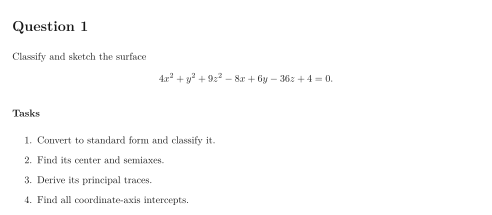
Classify and sketch the surface 4x2+y2+9z2−8x+6y−36z+4=0.4x^2+y^2+9z^2-8x+6y-36z+4=0.

Tasks

  1. Convert to standard form and classify it.

  2. Find its center and semiaxes.

  3. Derive its principal traces.

  4. Find all coordinate-axis intercepts.

Original worksheet page 1: question and worked solution for 1-4-001
Show solutionHide solution

Question 1 – Solution

Strategy Group like variables and complete each square.

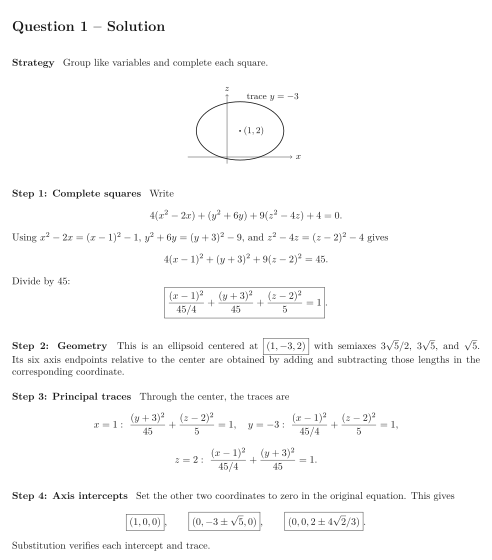
See the diagram in the original worksheet below.

Step 1: Complete squares Write 4(x2−2x)+(y2+6y)+9(z2−4z)+4=0.4(x^2-2x)+(y^2+6y)+9(z^2-4z)+4=0. Using x2−2x=(x−1)2−1x^2-2x=(x-1)^2-1, y2+6y=(y+3)2−9y^2+6y=(y+3)^2-9, and z2−4z=(z−2)2−4z^2-4z=(z-2)^2-4 gives 4(x−1)2+(y+3)2+9(z−2)2=45.4(x-1)^2+(y+3)^2+9(z-2)^2=45. Divide by 4545: (x−1)245/4+(y+3)245+(z−2)25=1.\boxed{\frac{(x-1)^2}{45/4}+\frac{(y+3)^2}{45}+\frac{(z-2)^2}{5}=1}.

Step 2: Geometry This is an ellipsoid centered at (1,−3,2)\boxed{(1,-3,2)} with semiaxes 35/23\sqrt 5/2, 353\sqrt 5, and 5\sqrt 5. Its six axis endpoints relative to the center are obtained by adding and subtracting those lengths in the corresponding coordinate.

Step 3: Principal traces Through the center, the traces are x=1:(y+3)245+(z−2)25=1,y=−3:(x−1)245/4+(z−2)25=1,x=1:\ \frac{(y+3)^2}{45}+\frac{(z-2)^2}{5}=1,\quad y=-3:\ \frac{(x-1)^2}{45/4}+\frac{(z-2)^2}{5}=1, z=2:(x−1)245/4+(y+3)245=1.z=2:\ \frac{(x-1)^2}{45/4}+\frac{(y+3)^2}{45}=1.

Step 4: Axis intercepts Set the other two coordinates to zero in the original equation. This gives (1,0,0),(0,−3±5,0),(0,0,2±42/3).\boxed{(1,0,0)},\qquad \boxed{(0,-3\pm\sqrt 5,0)},\qquad \boxed{(0,0,2\pm 4\sqrt 2/3)}. Substitution verifies each intercept and trace.
Original worksheet page 2: question and worked solution for 1-4-001

Original worksheet layout. Use Enlarge or open the PDF for a closer view.