Question 4
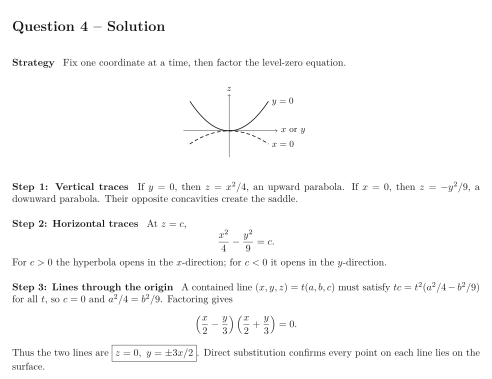
Analyze the hyperbolic paraboloid
Tasks
Derive the principal vertical traces.
Classify horizontal traces for .
Find every line through the origin contained in the surface.
Justify the term “saddle.”
Show solutionHide solution
Question 4 – Solution
Strategy Fix one coordinate at a time, then factor the level-zero equation.
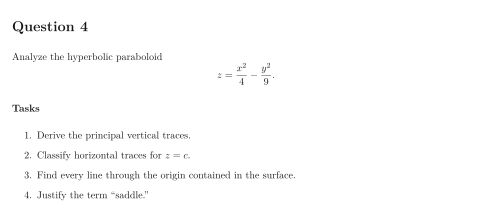
See the diagram in the original worksheet below.
Step 1: Vertical traces If , then , an upward parabola. If , then , a downward parabola. Their opposite concavities create the saddle.
Step 2: Horizontal traces At , For the hyperbola opens in the -direction; for it opens in the -direction.
Step 3: Lines through the origin A contained line must satisfy for all , so and . Factoring gives Thus the two lines are . Direct substitution confirms every point on each line lies on the surface.