Functions of Several Variables — Question 1

PDF ↗

Question 1

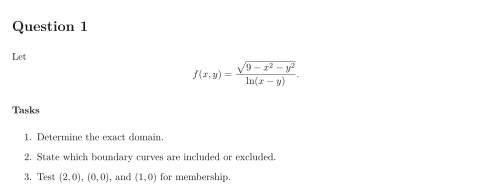
Let f(x,y)=9−x2−y2ln⁡(x−y).f(x,y)=\frac{\sqrt{9-x^2-y^2}}{\ln(x-y)}.

Tasks

  1. Determine the exact domain.

  2. State which boundary curves are included or excluded.

  3. Test (2,0)(2,0), (0,0)(0,0), and (1,0)(1,0) for membership.

Original worksheet page 1: question and worked solution for 1-5-001
Show solutionHide solution

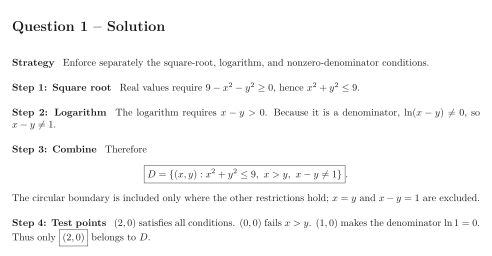
Question 1 – Solution

Strategy Enforce separately the square-root, logarithm, and nonzero-denominator conditions.

Step 1: Square root Real values require 9−x2−y2≥09-x^2-y^2\ge 0, hence x2+y2≤9x^2+y^2\le 9.

Step 2: Logarithm The logarithm requires x−y>0x-y>0. Because it is a denominator, ln⁡(x−y)≠0\ln(x-y)\ne 0, so x−y≠1x-y\ne 1.

Step 3: Combine Therefore D={(x,y):x2+y2≤9,x>y,x−y≠1}.\boxed{D=\{(x,y):x^2+y^2\le 9,\ x>y,\ x-y\ne 1\}}. The circular boundary is included only where the other restrictions hold; x=yx=y and x−y=1x-y=1 are excluded.

Step 4: Test points (2,0)(2,0) satisfies all conditions. (0,0)(0,0) fails x>yx>y. (1,0)(1,0) makes the denominator ln⁡1=0\ln 1=0. Thus only (2,0)\boxed{(2,0)} belongs to DD.

Original worksheet page 2: question and worked solution for 1-5-001

Original worksheet layout. Use Enlarge or open the PDF for a closer view.