Question 9
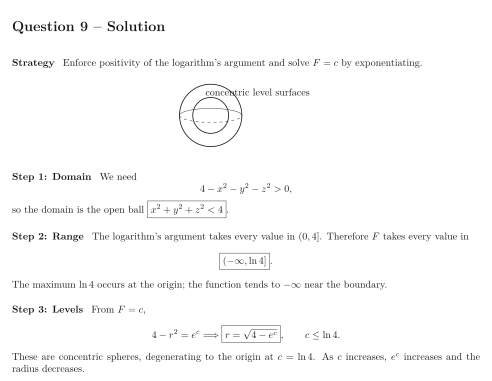
Let
Tasks
Find its domain and range.
Describe every level surface .
Determine how the level radius changes as increases.
Show solutionHide solution
Question 9 – Solution
Strategy Enforce positivity of the logarithm’s argument and solve by exponentiating.
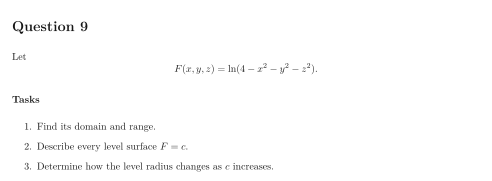
See the diagram in the original worksheet below.
Step 1: Domain We need so the domain is the open ball .
Step 2: Range The logarithm’s argument takes every value in . Therefore takes every value in The maximum occurs at the origin; the function tends to near the boundary.
Step 3: Levels From , These are concentric spheres, degenerating to the origin at . As increases, increases and the radius decreases.