Vector Functions β€” Question 1

PDF β†—

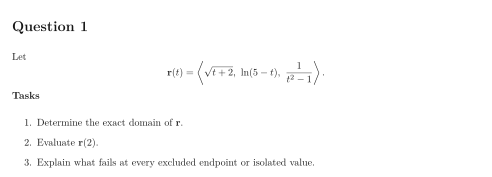
Question 1

Let 𝒓(t)=⟨t+2,ln(5βˆ’t),1t2βˆ’1⟩.\mathbf r(t)=\left\langle \sqrt{t+2},\ \ln(5-t),\ \dfrac{1}{t^2-1}\right\rangle. Tasks

  1. Determine the exact domain of 𝒓\mathbf r.

  2. Evaluate 𝒓(2)\mathbf r(2).

  3. Explain what fails at every excluded endpoint or isolated value.
Original worksheet page 1: question and worked solution for 1-6-001
Show solutionHide solution

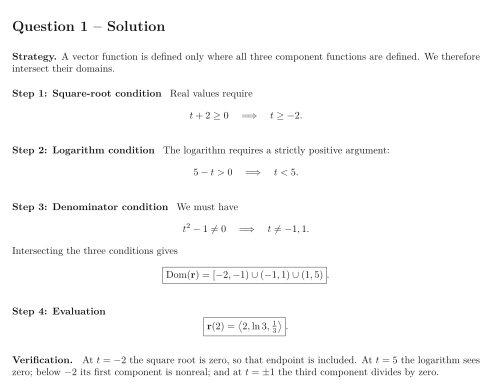
Question 1 – Solution

Strategy. A vector function is defined only where all three component functions are defined. We therefore intersect their domains.

Step 1: Square-root condition Real values require t+2β‰₯0β‡’tβ‰₯βˆ’2.t+2\ge 0\quad\Longrightarrow\quad t\ge-2.

Step 2: Logarithm condition The logarithm requires a strictly positive argument: 5βˆ’t>0β‡’t<5.5-t>0\quad\Longrightarrow\quad t<5.

Step 3: Denominator condition We must have t2βˆ’1β‰ 0β‡’tβ‰ βˆ’1,1.t^2-1\ne 0\quad\Longrightarrow\quad t\ne-1,1. Intersecting the three conditions gives Dom⁡(𝒓)=[βˆ’2,βˆ’1)βˆͺ(βˆ’1,1)βˆͺ(1,5).\boxed{\operatorname{Dom}(\mathbf r)=[-2,-1)\cup(-1,1)\cup(1,5)}.

Step 4: Evaluation 𝒓(2)=⟨2,ln3,13⟩.\boxed{\mathbf r(2)=\left\langle 2,\ln 3,\tfrac 13\right\rangle}.

Verification. At t=βˆ’2t=-2 the square root is zero, so that endpoint is included. At t=5t=5 the logarithm sees zero; below βˆ’2-2 its first component is nonreal; and at t=Β±1t=\pm 1 the third component divides by zero.

Original worksheet page 2: question and worked solution for 1-6-001

Original worksheet layout. Use Enlarge or open the PDF for a closer view.