Vector Functions β€” Question 7

PDF β†—

Question 7

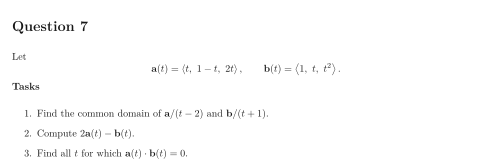
Let 𝒂(t)=⟨t,1βˆ’t,2t⟩,𝒃(t)=⟨1,t,t2⟩.\mathbf a(t)=\left\langle t,\ 1-t,\ 2t\right\rangle,\qquad \mathbf b(t)=\left\langle 1,\ t,\ t^2\right\rangle. Tasks

  1. Find the common domain of 𝒂/(tβˆ’2)\mathbf a/(t-2) and 𝒃/(t+1)\mathbf b/(t+1).

  2. Compute 2𝒂(t)βˆ’π’ƒ(t)2\mathbf a(t)-\mathbf b(t).

  3. Find all tt for which 𝒂(t)⋅𝒃(t)=0\mathbf a(t)\cdot\mathbf b(t)=0.

Original worksheet page 1: question and worked solution for 1-6-007
Show solutionHide solution

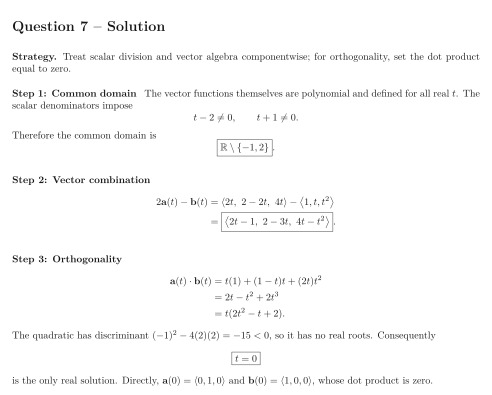
Question 7 – Solution

Strategy. Treat scalar division and vector algebra componentwise; for orthogonality, set the dot product equal to zero.

Step 1: Common domain The vector functions themselves are polynomial and defined for all real tt. The scalar denominators impose tβˆ’2β‰ 0,t+1β‰ 0.t-2\ne 0,\qquad t+1\ne 0. Therefore the common domain is ℝ\{βˆ’1,2}.\boxed{\mathbb R\setminus\{-1,2\}}.

Step 2: Vector combination 2𝒂(t)βˆ’π’ƒ(t)=⟨2t,2βˆ’2t,4tβŸ©βˆ’βŸ¨1,t,t2⟩=⟨2tβˆ’1,2βˆ’3t,4tβˆ’t2⟩.\begin{align*} 2\mathbf a(t)-\mathbf b(t) &=\left\langle 2t,\ 2-2t,\ 4t\right\rangle-\left\langle 1,t,t^2\right\rangle\\ &=\boxed{\left\langle 2t-1,\ 2-3t,\ 4t-t^2\right\rangle}. \end{align*}

Step 3: Orthogonality 𝒂(t)⋅𝒃(t)=t(1)+(1βˆ’t)t+(2t)t2=2tβˆ’t2+2t3=t(2t2βˆ’t+2).\begin{align*} \mathbf a(t)\cdot\mathbf b(t) &=t(1)+(1-t)t+(2t)t^2\\ &=2t-t^2+2t^3\\ &=t(2t^2-t+2). \end{align*} The quadratic has discriminant (βˆ’1)2βˆ’4(2)(2)=βˆ’15<0(-1)^2-4(2)(2)=-15<0, so it has no real roots. Consequently t=0\boxed{t=0} is the only real solution. Directly, 𝒂(0)=⟨0,1,0⟩\mathbf a(0)=\left\langle 0,1,0\right\rangle and 𝒃(0)=⟨1,0,0⟩\mathbf b(0)=\left\langle 1,0,0\right\rangle, whose dot product is zero.

Original worksheet page 2: question and worked solution for 1-6-007

Original worksheet layout. Use Enlarge or open the PDF for a closer view.