Calculus with Vector Functions β€” Question 1

PDF β†—

Question 1

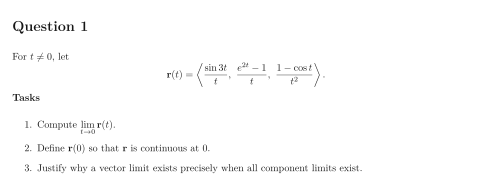
For tβ‰ 0t\ne 0, let 𝒓(t)=⟨sin⁡3tt,e2tβˆ’1t,1βˆ’cos⁡tt2⟩.\mathbf r(t)=\left\langle \dfrac{\sin 3t}{t},\ \dfrac{e^{2t}-1}{t},\ \dfrac{1-\cos t}{t^2}\right\rangle. Tasks

  1. Compute lim⁡tβ†’0𝒓(t)\displaystyle\lim_{t\to 0}\mathbf r(t).

  2. Define 𝒓(0)\mathbf r(0) so that 𝒓\mathbf r is continuous at 00.

  3. Justify why a vector limit exists precisely when all component limits exist.
Original worksheet page 1: question and worked solution for 1-7-001
Show solutionHide solution

Question 1 – Solution

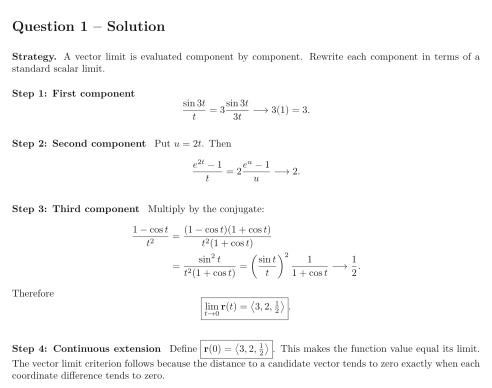
Strategy. A vector limit is evaluated component by component. Rewrite each component in terms of a standard scalar limit.

Step 1: First component sin⁡3tt=3sin⁡3t3tβ†’3(1)=3.\frac{\sin 3t}{t}=3\frac{\sin 3t}{3t}\longrightarrow 3(1)=3.

Step 2: Second component Put u=2tu=2t. Then e2tβˆ’1t=2euβˆ’1uβ†’2.\frac{e^{2t}-1}{t}=2\frac{e^u-1}{u}\longrightarrow 2.

Step 3: Third component Multiply by the conjugate: 1βˆ’cos⁡tt2=(1βˆ’cos⁡t)(1+cos⁡t)t2(1+cos⁡t)=sin⁡2tt2(1+cos⁡t)=(sin⁡tt)211+cos⁡tβ†’12.\begin{align*} \frac{1-\cos t}{t^2} &=\frac{(1-\cos t)(1+\cos t)}{t^2(1+\cos t)}\\ &=\frac{\sin^2t}{t^2(1+\cos t)} =\left(\frac{\sin t}{t}\right)^2\frac 1{1+\cos t} \longrightarrow\frac 12. \end{align*} Therefore limtβ†’0𝒓(t)=⟨3,2,12⟩.\boxed{\lim_{t\to 0}\mathbf r(t)=\left\langle 3,2,\tfrac 12\right\rangle}.

Step 4: Continuous extension Define 𝒓(0)=⟨3,2,12⟩\boxed{\mathbf r(0)=\left\langle 3,2,\tfrac 12\right\rangle}. This makes the function value equal its limit. The vector limit criterion follows because the distance to a candidate vector tends to zero exactly when each coordinate difference tends to zero.
Original worksheet page 2: question and worked solution for 1-7-001

Original worksheet layout. Use Enlarge or open the PDF for a closer view.