Calculus with Vector Functions β€” Question 8

PDF β†—

Question 8

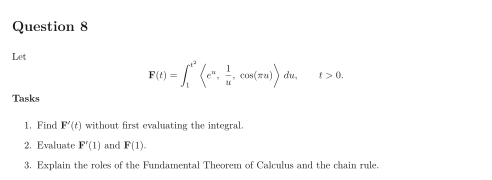
Let 𝑭(t)=∫1t2⟨eu,1u,cos(Ο€u)⟩du,t>0.\mathbf F(t)=\int_1^{t^2}\left\langle e^u,\ \frac 1u,\ \cos(\pi u)\right\rangle\,du, \qquad t>0. Tasks

  1. Find 𝑭′(t)\mathbf F'(t) without first evaluating the integral.

  2. Evaluate 𝑭′(1)\mathbf F'(1) and 𝑭(1)\mathbf F(1).

  3. Explain the roles of the Fundamental Theorem of Calculus and the chain rule.
Original worksheet page 1: question and worked solution for 1-7-008
Show solutionHide solution

Question 8 – Solution

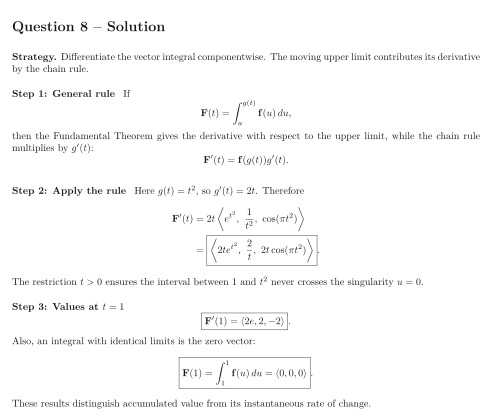
Strategy. Differentiate the vector integral componentwise. The moving upper limit contributes its derivative by the chain rule.

Step 1: General rule If 𝑭(t)=∫ag(t)𝒇(u)du,\mathbf F(t)=\int_a^{g(t)}\mathbf f(u)\,du, then the Fundamental Theorem gives the derivative with respect to the upper limit, while the chain rule multiplies by gβ€²(t)g'(t): 𝑭′(t)=𝒇(g(t))gβ€²(t).\mathbf F'(t)=\mathbf f(g(t))g'(t).

Step 2: Apply the rule Here g(t)=t2g(t)=t^2, so gβ€²(t)=2tg'(t)=2t. Therefore 𝑭′(t)=2t⟨et2,1t2,cos(Ο€t2)⟩=⟨2tet2,2t,2tcos(Ο€t2)⟩.\begin{align*} \mathbf F'(t) &=2t\left\langle e^{t^2},\ \frac 1{t^2},\ \cos(\pi t^2)\right\rangle\\ &=\boxed{\left\langle 2te^{t^2},\ \frac 2t,\ 2t\cos(\pi t^2)\right\rangle}. \end{align*} The restriction t>0t>0 ensures the interval between 11 and t2t^2 never crosses the singularity u=0u=0.

Step 3: Values at t=1t=1 𝑭′(1)=⟨2e,2,βˆ’2⟩.\boxed{\mathbf F'(1)=\left\langle 2e,2,-2\right\rangle}. Also, an integral with identical limits is the zero vector: 𝑭(1)=∫11𝒇(u)du=⟨0,0,0⟩.\boxed{\mathbf F(1)=\int_1^1\mathbf f(u)\,du=\left\langle 0,0,0\right\rangle}. These results distinguish accumulated value from its instantaneous rate of change.
Original worksheet page 2: question and worked solution for 1-7-008

Original worksheet layout. Use Enlarge or open the PDF for a closer view.