Calculus with Vector Functions β€” Question 10

PDF β†—

Question 10

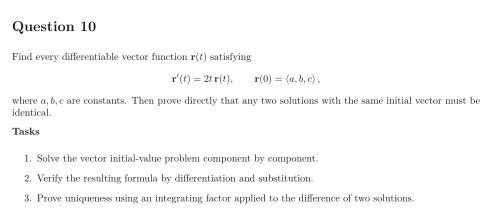
Find every differentiable vector function 𝒓(t)\mathbf r(t) satisfying 𝒓′(t)=2t𝒓(t),𝒓(0)=⟨a,b,c⟩,\mathbf r'(t)=2t\,\mathbf r(t),\qquad \mathbf r(0)=\left\langle a,b,c\right\rangle, where a,b,ca,b,c are constants. Then prove directly that any two solutions with the same initial vector must be identical.

Tasks

  1. Solve the vector initial-value problem component by component.

  2. Verify the resulting formula by differentiation and substitution.

  3. Prove uniqueness using an integrating factor applied to the difference of two solutions.
Original worksheet page 1: question and worked solution for 1-7-010
Show solutionHide solution

Question 10 – Solution

Strategy. The vector equation is three identical scalar equations. Solve them componentwise, then prove uniqueness with an integrating factor.

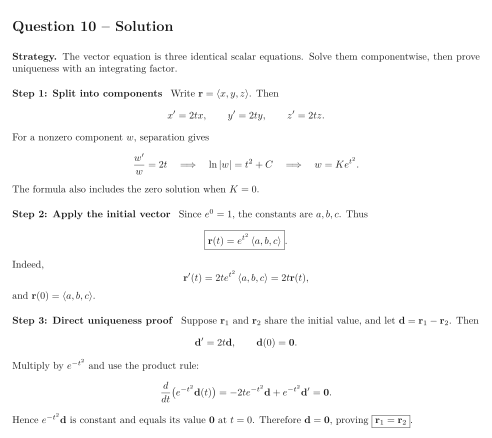
Step 1: Split into components Write 𝒓=⟨x,y,z⟩\mathbf r=\left\langle x,y,z\right\rangle. Then xβ€²=2tx,yβ€²=2ty,zβ€²=2tz.x'=2tx,\qquad y'=2ty,\qquad z'=2tz. For a nonzero component ww, separation gives wβ€²w=2tβ‡’ln⁡|w|=t2+Cβ‡’w=Ket2.\frac{w'}w=2t \quad\Longrightarrow\quad \ln|w|=t^2+C \quad\Longrightarrow\quad w=Ke^{t^2}. The formula also includes the zero solution when K=0K=0.

Step 2: Apply the initial vector Since e0=1e^0=1, the constants are a,b,ca,b,c. Thus 𝒓(t)=et2⟨a,b,c⟩.\boxed{\mathbf r(t)=e^{t^2}\left\langle a,b,c\right\rangle}. Indeed, 𝒓′(t)=2tet2⟨a,b,c⟩=2t𝒓(t),\mathbf r'(t)=2te^{t^2}\left\langle a,b,c\right\rangle=2t\mathbf r(t), and 𝒓(0)=⟨a,b,c⟩\mathbf r(0)=\left\langle a,b,c\right\rangle.

Step 3: Direct uniqueness proof Suppose 𝒓1\mathbf r_1 and 𝒓2\mathbf r_2 share the initial value, and let 𝒅=𝒓1βˆ’π’“2\mathbf d=\mathbf r_1-\mathbf r_2. Then 𝒅′=2t𝒅,𝒅(0)=𝟎.\mathbf d'=2t\mathbf d,\qquad \mathbf d(0)=\mathbf 0. Multiply by eβˆ’t2e^{-t^2} and use the product rule: ddt(eβˆ’t2𝒅(t))=βˆ’2teβˆ’t2𝒅+eβˆ’t2𝒅′=𝟎.\frac d{dt}\bigl(e^{-t^2}\mathbf d(t)\bigr) =-2te^{-t^2}\mathbf d+e^{-t^2}\mathbf d'=\mathbf 0. Hence eβˆ’t2𝒅e^{-t^2}\mathbf d is constant and equals its value 𝟎\mathbf 0 at t=0t=0. Therefore 𝒅=𝟎\mathbf d=\mathbf 0, proving .

Original worksheet page 2: question and worked solution for 1-7-010

Original worksheet layout. Use Enlarge or open the PDF for a closer view.