Tangent, Normal and Binormal Vectors β€” Question 4

PDF β†—

Question 4

Let 𝒓\mathbf r be a regular curve for which 𝑻′(t)β‰ πŸŽ\mathbf T'(t)\ne\mathbf 0.

Tasks

  1. Prove that 𝑻(t)⋅𝑡(t)=0\mathbf T(t)\cdot\mathbf N(t)=0.

  2. Prove that 𝑩(t)=𝑻(t)×𝑡(t)\mathbf B(t)=\mathbf T(t)\times\mathbf N(t) is a unit vector.

  3. Explain why (𝑻,𝑡,𝑩)(\mathbf T,\mathbf N,\mathbf B) is a right-handed orthonormal frame.

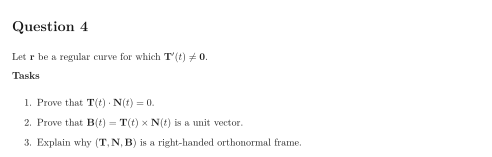
Original worksheet page 1: question and worked solution for 1-8-004
Show solutionHide solution

Question 4 – Solution

Strategy. Differentiate the invariant 𝑻⋅𝑻=1\mathbf T\cdot\mathbf T=1, then use standard cross-product identities.

See the diagram in the original worksheet below.

Step 1: Tangent–normal orthogonality Since 𝑻\mathbf T is a unit vector, 𝑻(t)⋅𝑻(t)=1.\mathbf T(t)\cdot\mathbf T(t)=1. Differentiate using the dot-product rule: 𝑻′⋅𝑻+𝑻⋅𝑻′=0β‡’2𝑻⋅𝑻′=0.\mathbf T'\cdot\mathbf T+\mathbf T\cdot\mathbf T'=0 \quad\Longrightarrow\quad 2\mathbf T\cdot\mathbf T'=0. Because 𝑡=𝑻′/βˆ₯𝑻′βˆ₯\mathbf N=\mathbf T'/\|\mathbf T'\| and the denominator is nonzero, 𝑻⋅𝑡=0.\boxed{\mathbf T\cdot\mathbf N=0}.

Step 2: Length of 𝑩\mathbf B For vectors separated by angle ΞΈ\theta, βˆ₯𝑻×𝑡βˆ₯=βˆ₯𝑻βˆ₯βˆ₯𝑡βˆ₯sin⁡ΞΈ.\|\mathbf T\times\mathbf N\|=\|\mathbf T\|\,\|\mathbf N\|\sin\theta. Here both lengths are 11 and ΞΈ=Ο€/2\theta=\pi/2, so βˆ₯𝑩βˆ₯=1.\boxed{\|\mathbf B\|=1}. The cross product is perpendicular to both factors; hence 𝑩\mathbf B is orthogonal to both 𝑻\mathbf T and 𝑡\mathbf N.

Step 3: Orientation The ordered relation 𝑻×𝑡=𝑩\mathbf T\times\mathbf N=\mathbf B is exactly the right-hand rule. Thus the three mutually perpendicular unit vectors form a right-handed orthonormal frame.
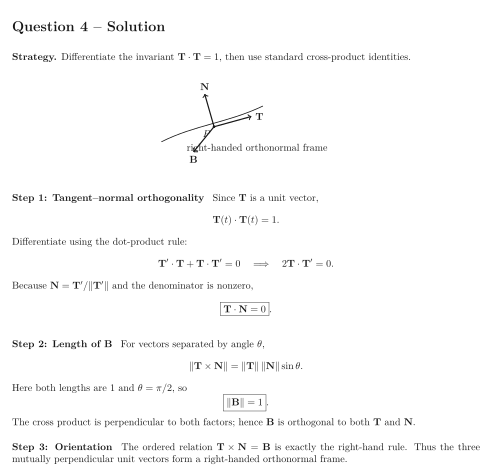
Original worksheet page 2: question and worked solution for 1-8-004

Original worksheet layout. Use Enlarge or open the PDF for a closer view.