Tangent, Normal and Binormal Vectors — Question 10

PDF ↗

Question 10

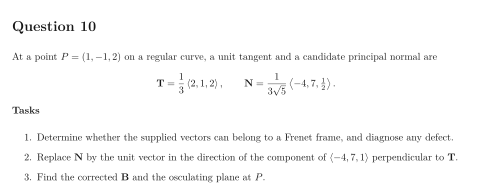
At a point P=(1,−1,2)P=(1,-1,2) on a regular curve, a unit tangent and a candidate principal normal are 𝑻=13⟨2,1,2⟩,𝑵=135⟨−4,7,12⟩.\mathbf T=\frac 13\left\langle 2,1,2\right\rangle,\qquad \mathbf N=\frac 1{3\sqrt 5}\left\langle -4,7,\tfrac 12\right\rangle. Tasks

  1. Determine whether the supplied vectors can belong to a Frenet frame, and diagnose any defect.

  2. Replace 𝑵\mathbf N by the unit vector in the direction of the component of ⟨−4,7,1⟩\left\langle -4,7,1\right\rangle perpendicular to 𝑻\mathbf T.

  3. Find the corrected 𝑩\mathbf B and the osculating plane at PP.

Original worksheet page 1: question and worked solution for 1-8-010
Show solutionHide solution

Question 10 – Solution

Strategy. First audit unit length and orthogonality. Then use vector projection to remove the tangential component from the proposed bending direction.

Step 1: Diagnose the supplied normal The tangent is unit because (4+1+4)/9=1(4+1+4)/9=1. But 𝑻⋅𝑵=2(−4)+1(7)+2(1/2)95=0,\mathbf T\cdot\mathbf N =\frac{2(-4)+1(7)+2(1/2)}{9\sqrt 5}=0, while ∥𝑵∥2=16+49+1/445=2920≠1.\|\mathbf N\|^2=\frac{16+49+1/4}{45}=\frac{29}{20}\ne 1. Thus it is perpendicular to 𝑻\mathbf T but is not a unit vector, so the data are not a Frenet frame.

Step 2: Correct the bending direction Let 𝒘=⟨−4,7,1⟩\mathbf w=\left\langle -4,7,1\right\rangle. Its tangential scalar component is 𝒘⋅𝑻=−8+7+23=13.\mathbf w\cdot\mathbf T=\frac{-8+7+2}{3}=\frac 13. Therefore 𝒘⟂=𝒘−(𝒘⋅𝑻)𝑻=⟨−4,7,1⟩−19⟨2,1,2⟩=19⟨−38,62,7⟩.\mathbf w_\perp=\mathbf w-(\mathbf w\cdot\mathbf T)\mathbf T =\left\langle -4,7,1\right\rangle-\frac 19\left\langle 2,1,2\right\rangle =\frac 19\left\langle -38,62,7\right\rangle. Since (−38)2+622+72=5337=3593\sqrt{(-38)^2+62^2+7^2}=\sqrt{5337}=3\sqrt{593}, 𝑵̂=13593⟨−38,62,7⟩.\boxed{\widehat{\mathbf N}=\frac 1{3\sqrt{593}}\left\langle -38,62,7\right\rangle}.

Step 3: Binormal and osculating plane 𝑩=𝑻×𝑵̂=1593⟨−13,−10,18⟩.\mathbf B=\mathbf T\times\widehat{\mathbf N} =\boxed{\frac 1{\sqrt{593}}\left\langle -13,-10,18\right\rangle}. The numerator has length 169+100+324=593\sqrt{169+100+324}=\sqrt{593}. Since 𝑩\mathbf B is normal to the osculating plane through PP, −13(x−1)−10(y+1)+18(z−2)=0,-13(x-1)-10(y+1)+18(z-2)=0, or 13x+10y−18z+33=0.\boxed{13x+10y-18z+33=0}. Substitution of PP gives zero, and the construction guarantees a right-handed orthonormal frame.
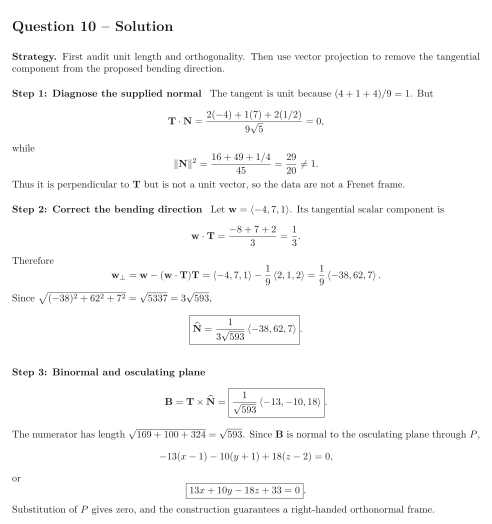
Original worksheet page 2: question and worked solution for 1-8-010

Original worksheet layout. Use Enlarge or open the PDF for a closer view.