Arc Length with Vector Functions — Question 7

PDF ↗

Question 7

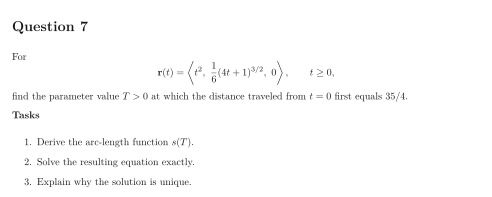
For 𝒓(t)=⟨t2,16(4t+1)3/2,0⟩,t≥0,\mathbf r(t)=\left\langle t^2,\ \frac 16(4t+1)^{3/2},\ 0\right\rangle,\qquad t\ge 0, find the parameter value T>0T>0 at which the distance traveled from t=0t=0 first equals 35/435/4.

Tasks

  1. Derive the arc-length function s(T)s(T).

  2. Solve the resulting equation exactly.

  3. Explain why the solution is unique.

Original worksheet page 1: question and worked solution for 1-9-007
Show solutionHide solution

Question 7 – Solution

Strategy. Differentiate carefully; the squared speed is a perfect square on the stated domain.

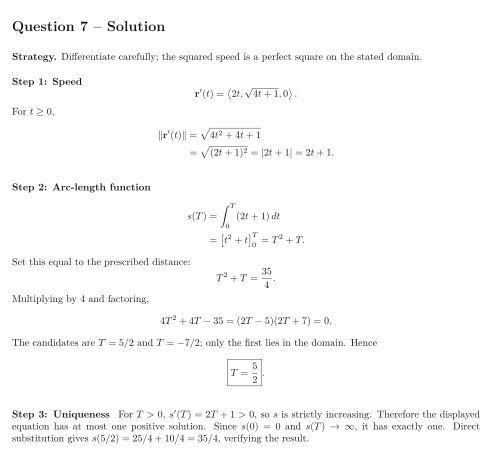
Step 1: Speed 𝒓′(t)=⟨2t,4t+1,0⟩.\mathbf r'(t)=\left\langle 2t,\sqrt{4t+1},0\right\rangle. For t≥0t\ge 0, ∥𝒓′(t)∥=4t2+4t+1=(2t+1)2=|2t+1|=2t+1.\begin{align*} \|\mathbf r'(t)\| &=\sqrt{4t^2+4t+1}\\ &=\sqrt{(2t+1)^2}=|2t+1|=2t+1. \end{align*}

Step 2: Arc-length function s(T)=∫0T(2t+1)dt=[t2+t]0T=T2+T.\begin{align*} s(T)&=\int_0^T(2t+1)\,dt\\ &=\left[t^2+t\right]_0^T=T^2+T. \end{align*} Set this equal to the prescribed distance: T2+T=354.T^2+T=\frac{35}{4}. Multiplying by 44 and factoring, 4T2+4T−35=(2T−5)(2T+7)=0.4T^2+4T-35=(2T-5)(2T+7)=0. The candidates are T=5/2T=5/2 and T=−7/2T=-7/2; only the first lies in the domain. Hence T=52.\boxed{T=\frac 52}.

Step 3: Uniqueness For T>0T>0, s′(T)=2T+1>0s'(T)=2T+1>0, so ss is strictly increasing. Therefore the displayed equation has at most one positive solution. Since s(0)=0s(0)=0 and s(T)→∞s(T)\to\infty, it has exactly one. Direct substitution gives s(5/2)=25/4+10/4=35/4s(5/2)=25/4+10/4=35/4, verifying the result.

Original worksheet page 2: question and worked solution for 1-9-007

Original worksheet layout. Use Enlarge or open the PDF for a closer view.