Limits — Question 6

PDF ↗

Question 6

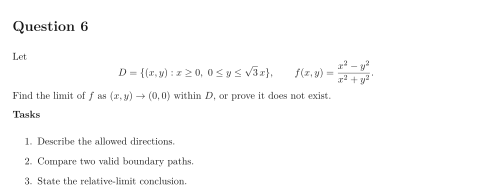
Let D={(x,y):x≥0,0≤y≤3x},f(x,y)=x2−y2x2+y2.D=\{(x,y):x\ge 0,\ 0\le y\le\sqrt 3\,x\},\qquad f(x,y)=\frac{x^2-y^2}{x^2+y^2}. Find the limit of ff as (x,y)→(0,0)(x,y)\to(0,0) within DD, or prove it does not exist.

Tasks

  1. Describe the allowed directions.

  2. Compare two valid boundary paths.

  3. State the relative-limit conclusion.

Original worksheet page 1: question and worked solution for 2-1-006
Show solutionHide solution

Question 6 – Solution

Strategy. A relative limit uses only paths in the domain, but all such paths must still agree.

See the diagram in the original worksheet below.

Step 1: Directions The wedge is 0≤θ≤π/30\le\theta\le\pi/3. In polar form, f=r2cos⁡2θ−r2sin⁡2θr2=cos⁡2θ.f=\frac{r^2\cos^2\theta-r^2\sin^2\theta}{r^2}=\cos 2\theta.

Step 2: Boundary paths Along y=0y=0 (θ=0\theta=0), f=1f=1. Along y=3xy=\sqrt 3x (θ=π/3\theta=\pi/3), f=cos⁡(2π/3)=−12.f=\cos(2\pi/3)=-\frac 12. Both paths stay in DD and approach the origin.

Conclusion. Because the two permitted approaches disagree, lim(x,y)→(0,0)(x,y)∈Df(x,y) does not exist.\begin{gathered}\boxed{\displaystyle \lim_{\substack{(x,y)\to(0,0)\\(x,y)\in D}}f(x,y)\text{ does not exist}.}\end{gathered}

Original worksheet page 2: question and worked solution for 2-1-006

Original worksheet layout. Use Enlarge or open the PDF for a closer view.