Limits — Question 8

PDF ↗

Question 8

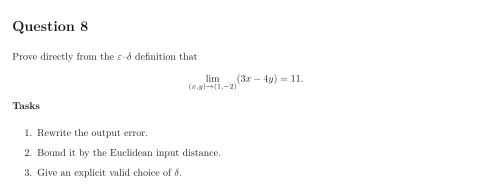
Prove directly from the ε\varepsilon–δ\delta definition that lim(x,y)→(1,−2)(3x−4y)=11.\lim_{(x,y)\to(1,-2)}(3x-4y)=11. Tasks

  1. Rewrite the output error.

  2. Bound it by the Euclidean input distance.

  3. Give an explicit valid choice of δ\delta.

Original worksheet page 1: question and worked solution for 2-1-008
Show solutionHide solution

Question 8 – Solution

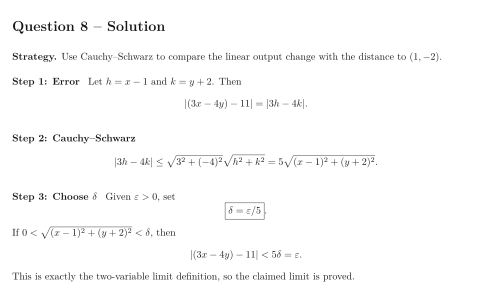
Strategy. Use Cauchy–Schwarz to compare the linear output change with the distance to (1,−2)(1,-2).

Step 1: Error Let h=x−1h=x-1 and k=y+2k=y+2. Then |(3x−4y)−11|=|3h−4k|.|(3x-4y)-11|=|3h-4k|.

Step 2: Cauchy–Schwarz |3h−4k|≤32+(−4)2h2+k2=5(x−1)2+(y+2)2.|3h-4k|\le\sqrt{3^2+(-4)^2}\sqrt{h^2+k^2}=5\sqrt{(x-1)^2+(y+2)^2}.

Step 3: Choose δ\delta Given ε>0\varepsilon>0, set δ=ε/5.\boxed{\delta=\varepsilon/5}. If 0<(x−1)2+(y+2)2<δ0<\sqrt{(x-1)^2+(y+2)^2}<\delta, then |(3x−4y)−11|<5δ=ε.|(3x-4y)-11|<5\delta=\varepsilon. This is exactly the two-variable limit definition, so the claimed limit is proved.

Original worksheet page 2: question and worked solution for 2-1-008

Original worksheet layout. Use Enlarge or open the PDF for a closer view.